

Are Nialaya Bracelets Worth It? What to Buy Instead
Last Updated: October 26, 2026
Quick Summary
Nialaya bracelets are designer beaded bracelets priced for luxury positioning, with gemstone-and-silver builds commonly landing between roughly $150 and $400. Direct-to-consumer alternatives built on the same natural stone typically cost $20 to $60 per piece, so buy on specs like natural stone, closure type, and fit rather than the name on the tag.
- Designer beaded bracelets typically retail in the low hundreds per piece, often $150 to $400.
- Direct-to-consumer bracelets on the same natural stone land at $20 to $60 per piece.
- A $29.99 natural stone stretch bracelet worn daily for two years costs about $15 a year.
- The ILC lava stone bracelet is $24.99 and the tiger eye and lava pair is $49.99.
- ILC stretch bracelets measure 7.5 inches and fit wrists from about 6.7 to 7.9 inches.
Table of Contents
- What You Pay for in Nialaya Bracelets
- Side-by-Side: Materials, Construction and Price
- Affordable Men's Bracelets That Still Look Expensive
- Natural Stone Bracelets for Men: What the Beads Actually Do
- Men's Bracelets for Work: Which Styles Pass in an Office
- Men's Bracelet Sizing Guide: Get the Fit Right First Time
- Durability and Care: Keeping Stone and Hematite Looking New
- Pick Your Bracelet and Wear It This Week
- Frequently Asked Questions
What You Pay for in Nialaya Bracelets
Nialaya bracelets are designer beaded bracelets built from gemstones, sterling silver accents, and hand-knotted cords, priced for luxury positioning rather than the raw cost of the beads. If you are weighing Nialaya alternatives, start by understanding what the premium covers. This guide breaks down the markup, compares materials, and shows what to buy instead.
Where the Price Comes From
Most of what you pay for goes into three buckets: brand marketing, retail distribution, and packaging. A designer bracelet passes through wholesale, boutique markup, and import duties before it reaches a display case, costs unrelated to the stones on your wrist.
The beads are a small part of the bill: genuine gemstone beads are widely available and affordable at scale, and the silver weight in a bracelet is modest.
What you are really buying is the name on the tag. That is fine if the name matters to you. It is a poor deal if you want the look.
What the Price Does Not Buy You
A higher price does not mean better durability. Beaded bracelets fail at the string, not the stone, and a cord wears out on a similar timeline whether it sits in a designer box or a plain pouch.
The price also does not buy a better fit, most beaded bracelets use a fixed circumference, or versatility, since a bold designer piece often locks you into one look.
Side-by-Side: Materials, Construction and Price
Most shopping guides stop at a photo and a price. This section compares what each build is made of, how it is put together, how it wears, and what the money buys at each tier, so you can judge any option, including ours.
The Four Specs That Decide Quality
Ignore the logo for a moment. Four measurable specs separate a bracelet that lasts from one that ends up in a drawer:
- Bead material. Natural stone (lava stone, tiger eye, hematite, jade, onyx) versus glass, acrylic, or dyed howlite passed off as turquoise. Natural stone varies bead to bead, which is the tell. Synthetic beads are uniform and cheaper.
- Bead size. 6 mm reads subtle, 8 mm is the standard men's size, and 10 mm and up is a statement. Size drives both presence and weight on the wrist.
- Closure type. Stretch cord, knotted cord with an adjustable slider, or a metal clasp (lobster, box, or magnetic). Each has a different failure point and a different fit range.
Designer Tier vs. Direct-to-Consumer Tier
Designer beaded bracelets typically retail in the low hundreds per piece, with gemstone-and-silver builds commonly landing between roughly $150 and $400. Direct-to-consumer bracelets built on the same natural stone typically land in the $20 to $60 range per piece, or roughly $40 to $100 for a matched pair.
What changes between those tiers is rarely the bead. Genuine 8 mm natural stone beads are inexpensive at wholesale; what changes is the name on the tag, the box, and how much of the price is distribution.
Construction Comparison
| Feature | Typical Designer Bracelet | ILC Lava Stone | ILC Tiger Eye | ILC Pair |
|---|---|---|---|---|
| Bead size | Varies, often 8 mm | 8 mm | 8 mm | 8 mm |
| Stone type | Gemstone mix | Natural lava stone | Natural tiger eye | Both |
| Accents | Sterling silver or gold-tone | Polished hematite | Polished hematite | Polished hematite |
| Closure | Clasp or knotted cord | Stretch, no clasp | Stretch, no clasp | Stretch, no clasp |
| Circumference | Fixed | 7.5 in | 7.5 in | 7.5 in each |
| Price | Premium, often $150-$400+ | $24.99 | $29.99 | $49.99 |
What Each Closure Actually Means for Wear
- Stretch cord. Slips over the hand with no hardware to fiddle with and no clasp to tarnish. The cord is the wear item; most stretch bracelets last one to three years of daily wear before the cord needs replacing. Best for everyday wear and for anyone who takes a bracelet on and off often.
- Knotted adjustable cord. A sliding knot gives a wide fit range and a casual look. The knot can loosen over time and the cord can fray at the knot, so it needs occasional re-tightening.
- Metal clasp. The most secure fit and the most formal look, but the clasp is the failure point and plated clasps can tarnish or lose finish. A clasp also requires an accurate wrist measurement, since there is little give.
Value, Not Just Price
The honest value test is cost per year of wear, not sticker price. A $29.99 natural stone stretch bracelet worn daily for two years costs about $15 a year; a $250 designer piece worn the same way costs about $125 a year and fails at the same place, the cord.
That is the case for buying on specs: natural stone, a closure that matches how you wear it, and a fit range that matches your wrist. You can browse the full bracelet collection to compare styles, colors, and finishes side by side.
Affordable Men's Bracelets That Still Look Expensive
The best affordable men's bracelets share one trait: they use real materials and skip the logo. Texture and color do the work that a brand name usually does. Below are the two options we recommend, both built on genuine stone.
The ILC Men's Natural Lava Stone Bracelet at $24.99
Our pick for a first bracelet. The matte black lava stone reads as understated, and the polished hematite accents catch light without shouting.
The 8 mm beads give it enough presence to stand alone on a bare wrist. If you want to see the exact finish and buy it directly, you can view the lava stone bracelet.

Best for: A first bracelet or an everyday black accent. Skip if: You want warm tones rather than cool ones.
The ILC Men's Tiger Eye & Lava Stone Pair at $49.99
Two bracelets solve the layering problem in one purchase. The warm golden-brown tiger eye and textured black lava stone contrast well together, and each works alone. The set includes a velvet pouch and an ILC gift bag, making it a ready-made gift.
At $49.99 for two genuine stone bracelets plus packaging, the value is hard to argue with. You can see the pair and its gift packaging before you commit.

Best for: Layering, gifting, or splitting the set across two outfits. Skip if: You prefer a single minimal piece.
ILC Men’s Tiger Eye & Lava Stone Bracelet Pair →
Natural Stone Bracelets for Men: What the Beads Actually Do
Natural stone bracelets for men are made from genuine minerals rather than glass or plastic, and the appeal is visual and tactile: color, texture, and pattern that vary from bead to bead.
Tiger eye carries a shifting golden band that moves as the light changes. Lava stone is matte and porous, so it absorbs light rather than reflecting it.
If you want the deeper background on these stones, our tiger eye bracelet style and care guide covers meaning, styling, and maintenance in detail.
Men's Bracelets for Work: Which Styles Pass in an Office
For an office, choose a bracelet that stays quiet: dark or neutral stones, small beads, and no dangling charms. A black lava stone bracelet beside a watch reads as deliberate.
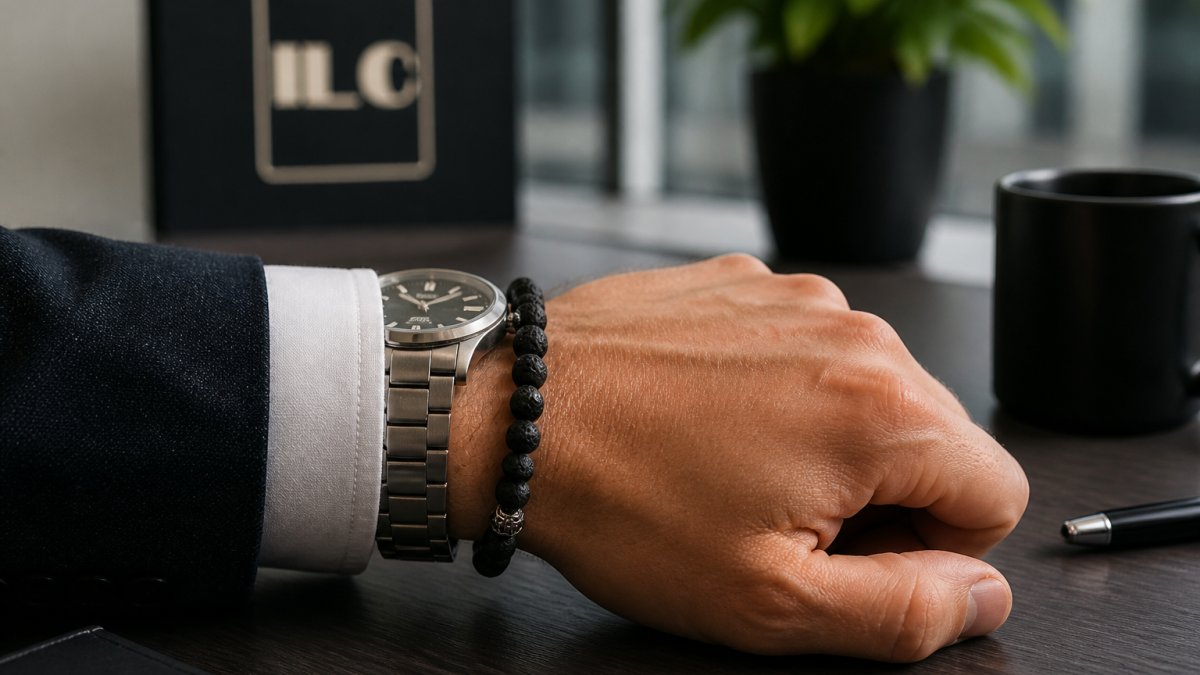
The rule is contrast, not competition. Your bracelet should sit next to your watch, not fight it. Keep the bead size modest at 8 mm and stick to one or two pieces.
Dress codes vary, and some client-facing roles call for a bare wrist. If you are building a work wardrobe, our guide on how to style men's bracelets covers pairing with shirts, cuffs, and watches.
Men's Bracelet Sizing Guide: Get the Fit Right First Time
Sizing is where most bracelet purchases go wrong. The fix is a two-minute measurement plus knowing how each closure type fits. Do this once and you stop guessing.
Measure Your Wrist in Two Minutes
Wrap a strip of paper or soft tape measure around your wrist just below the wrist bone, not over a watch. Note the length in inches, and measure snug, not tight.
Add about half an inch of ease for a comfortable fit and a quarter inch for a close fit. Bead diameter matters too: an 8 mm bead adds roughly a third of an inch to the effective inner circumference compared with a 6 mm bead, which is why two bracelets listed at the same length can feel different.
How Each Style Fits
- Stretch beaded. The most forgiving. The ILC bracelets measure 7.5 inches in circumference and fit wrists from about 6.7 to 7.9 inches. On a smaller wrist the bracelet sits slightly looser; on a larger wrist it sits closer. No clasp, so there is nothing to adjust and nothing to tarnish.
- Knotted adjustable. A sliding knot gives the widest fit range, often covering two or more inches of wrist variation. The trade-off is that the knot can loosen with wear and needs occasional re-tightening.
- Fixed clasp (link or beaded with a clasp). The least forgiving. A clasp bracelet needs an accurate measurement because there is little give, and a half-inch error is noticeable. This is the style most likely to be returned for fit.
Fit Ranges at a Glance
| Wrist size | Stretch 7.5 in | Knotted adjustable | Fixed clasp |
|---|---|---|---|
| Under 6.5 in | Loose; may slide | Good, tighten the knot | Order a smaller length |
| 6.7-7.9 in | Intended fit range | Good | Measure carefully |
| Over 8 in | Snug; check the listing | Good, loosen the knot | Order a larger length |
Common Fit Mistakes
- Measuring over a watch or a shirt cuff, which adds length you do not need.
- Ordering a fixed-clasp bracelet without measuring at all, the most common fit mistake.
- Assuming natural stone beads stretch. They do not; only the cord does, and only slightly.
Fit and Layering
If you plan to stack two bracelets, size each to the same wrist measurement and expect the pair to sit slightly tighter together than either alone. The ILC pair is a matched set at 7.5 inches each, so the two sit together without one riding over the other.
Durability and Care: Keeping Stone and Hematite Looking New
Stone and hematite are durable, but the cord is the weak point. A few habits extend the life of any beaded bracelet.
- Roll the bracelet over your hand rather than stretching it wide
- Keep it away from perfume, chlorine, and harsh cleaners
- Wipe beads with a dry cloth; skip soaking
Hematite accents hold a polish well but can scratch against harder surfaces, so avoid stacking metal directly against them. Treat the cord as a wear item and replace the bracelet when it starts to fray.
Pick Your Bracelet and Wear It This Week
Designer pricing buys a name, not better stones. Genuine natural stone, a simple stretch build, and a fit that matches your wrist get you the look for a fraction of the cost.
Pick based on how you dress. Black lava stone covers casual and business casual. Tiger eye adds warmth. The pair covers both. Then measure your wrist, order once, and wear it.
You can browse the full bracelet collection to compare styles, colors, and finishes side by side.
Frequently Asked Questions
What brands are similar to Nialaya for men's bracelets?
Look for brands that use genuine natural stone beads, polished metal accents and stretch or adjustable construction, since that is the core of what Nialaya sells. I Look Classy makes three comparable options: the Natural Lava Stone Bracelet at $24.99, the Natural Tiger Eye Bracelet at $29.99, and the Tiger Eye & Lava Stone Pair at $49.99, which includes a velvet pouch and gift bag. All three use 8 mm genuine stone beads with hematite accents and stretch cord, so the materials match the category without the designer markup.
What are affordable alternatives to Nialaya bracelets?
Affordable men's bracelets in this style generally sit under $50. The ILC Lava Stone Bracelet is $24.99 and the Tiger Eye Bracelet is $29.99, both with genuine stone beads and polished hematite accents. The pair bundle at $49.99 gives you two bracelets plus gift packaging for roughly what one designer bracelet costs. If you want a layered look without buying twice, the bundle is the better value per bracelet.
Are Nialaya bracelets worth the price?
That depends on what you want from a bracelet. You are paying partly for the brand name and the retail experience, not only the beads. The materials in this category are natural stone, hematite accents and elastic cord, and those are available well below designer pricing. If the design and label matter to you, the designer price can be justified. If you want the look and the stone quality, a $25 to $50 bracelet delivers most of the same visual result.
How should a men's bracelet fit?
Measure your wrist where you plan to wear the bracelet, then compare it with the maker's recommended range. The ILC bracelets are 19 cm (about 7.5 inches) around with 8 mm beads, recommended for wrists of roughly 17 to 20 cm (6.7 to 7.9 inches). Expect a looser feel on smaller wrists and a closer fit on larger ones. Stretch construction means no clasp, so the bracelet should slide over your hand without pinching.
Can you wear a stone bracelet with a watch?
Yes, and it is one of the easiest ways to make a bracelet look intentional rather than accidental. Wear the watch on one wrist and one or two stone bracelets on the other, or stack a single slim bracelet on the same wrist as the watch if the beads are small enough not to scratch the case. Contrast helps: a matte black lava stone bracelet next to a steel watch reads sharper than two similar tones competing.
The hardest part of upgrading your look is not the budget: it is choosing a piece you will actually wear every day. That is where I Look Classy comes in. Our natural stone bracelets use genuine beads, polished hematite accents, and a clasp-free stretch fit, and every order ships from the USA with a simple 30-day return policy. Get started with I Look Classy and find a bracelet that looks sharp without the designer markup.
