

How to Style Men's Bracelets: A Complete 2026 Guide
Table of Contents
- Start with the Right Fit: A Men's Bracelet Fit Guide
- How to Wear Men's Bracelets with a Watch
- Men's Bracelet Stacking: How to Layer Without Looking Overdone
- Men's Bracelets for Business Casual and Professional Settings
- How Skin Tone and Metal Finish Work Together
- Matching Bracelets to Your Outfit and Occasion
- Caring for Your Bracelets: Maintenance That Keeps Them Looking Sharp
- Conclusion: Build a Wrist Game That Works for You
- Frequently Asked Questions
Last Updated: October 9, 2026
Start with the Right Fit: A Men's Bracelet Fit Guide
Fit comes before style when you style men's bracelets. A bracelet that slides past your hand or digs into your wrist ruins even the best outfit, so measuring first matters more than any trend.
Here's the good news: once you know your number, every future purchase gets easier.
How to Measure Your Wrist Circumference
Wrist circumference is the distance around your wrist at the point where you plan to wear the bracelet.
To measure it:
- Wrap a soft tape measure around your wrist, just below the wrist bone.
- Keep it snug, not tight. You should fit one finger under the tape.
- Write down the number in centimeters or inches.
- No tape measure? Wrap a strip of paper, mark it, and lay it flat against a ruler.
Most men land between roughly 17 and 20 cm, or about 6.7 to 7.9 inches.
How a Bracelet Should Sit on Your Wrist
A well-fitted bracelet rests close to the wrist bone with a little room to move.
- Too tight: leaves marks on your skin and feels uncomfortable by mid-day.
- Too loose: slides over your hand and catches on sleeves.
- Just right: stays put when you shake your arm, but never squeezes.
Stretch bracelets follow a simple rule: measure your wrist, then compare it to the listed circumference. A 19 cm bracelet on a 17 cm wrist sits looser. On a 20 cm wrist, it sits closer.
How Wrist Size and Arm Thickness Change What Looks Right
Most guides stop at the number. The real skill is scaling the bracelet's width and bulk to your frame.
Wrist circumference sets the band length. Wrist and forearm thickness set the band width. A wide cuff on a narrow wrist overpowers the arm; a thin cord on a thick wrist disappears.
Use this as a starting framework:
| Wrist Size | Wrist Character | Best Bracelet Width | What to Avoid |
|---|---|---|---|
| Under 17 cm (under 6.7 in) | Slim | 6-8 mm beads or a thin 4-6 mm cuff | Wide cuffs, chunky 12 mm beads |
| 17-19 cm (6.7-7.5 in) | Average | 8-10 mm beads, medium cuffs | Extremely thin cords that vanish |
| Over 19 cm (over 7.5 in) | Larger | 10-12 mm beads, wide cuffs | Delicate chains that look undersized |
A few practical rules that follow from the table:
- Bead diameter is the fastest lever. Going from 8 mm to 10 mm beads adds visible presence without changing the length.
- Match width to forearm, not just wrist. A man with a slim wrist but a thick forearm can carry a wider cuff than his wrist measurement alone suggests.
- Height matters too. Taller frames generally carry wider bands; shorter frames look cleaner with narrower ones.
Adjusting Fit for Different Clasp Types
Fit isn't only about length, the closure changes how a bracelet sits:
- Stretch cord: sized by circumference; a snug measurement is fine because the cord gives slightly.
- Lobster clasp or buckle: needs a true measurement plus about 1 cm (0.4 in) of slack for comfort.
- Cuff or bangle: must be sized to slip over the widest part of your hand, not your wrist. Measure around your knuckles with your thumb tucked in.
How to Wear Men's Bracelets with a Watch
You can wear a bracelet and a watch on the same wrist, but the pairing has to be deliberate. Two pieces fighting for the same space look cluttered; two pieces that echo each other look sharp.
The trick is balance. Match the weight of the bracelet to the weight of the watch, and match the metal finishes.
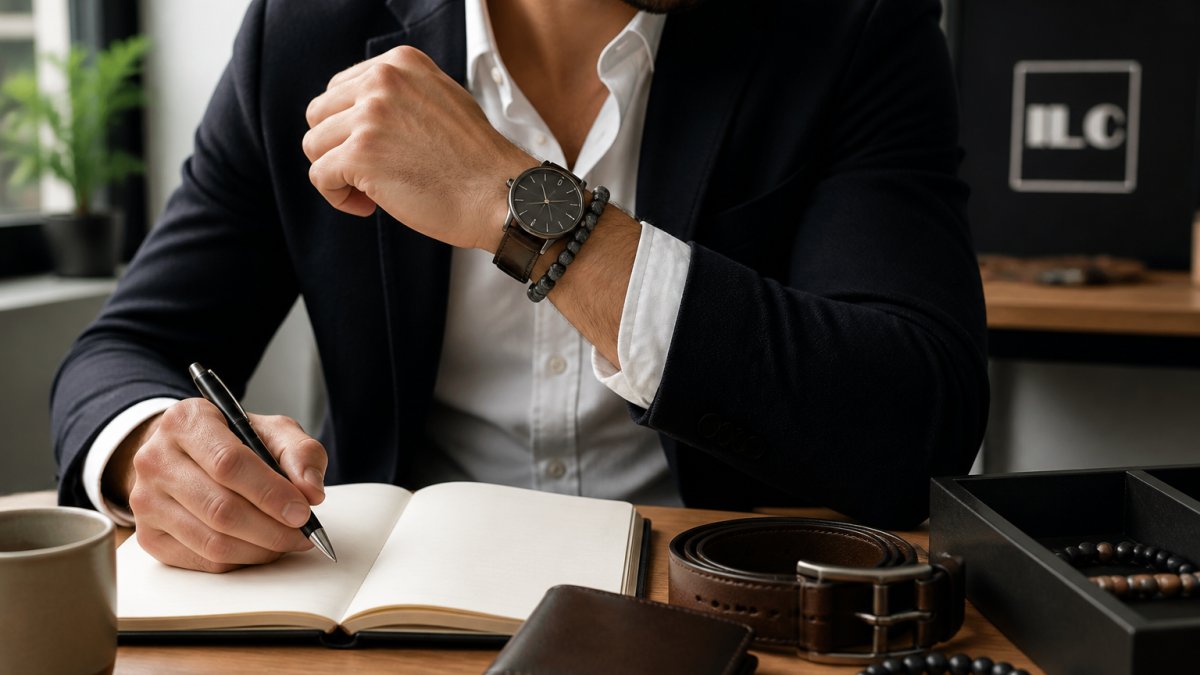
Which Wrist Gets the Watch and Which Gets the Bracelet
Most men wear both on the same wrist, with the watch closest to the hand and the bracelet sitting above it.
If the stack feels heavy, split them. Watch on your non-dominant wrist, bracelet on the other. This works especially well with a bulky dive watch paired with a slim beaded bracelet.
Matching Metal Finishes and Watch Styles
Keep your metal finish consistent. A silver-tone watch case pairs best with silver or hematite accents. A gold-tone case calls for warm tones.
For watch styles:
- Leather-strap dress watch: pair with a slim beaded or braided leather bracelet.
- Steel sports watch: pair with stone beads or a minimal cuff.
- Field watch: pair with a single natural stone bracelet for a rugged feel.
Avoid stacking a heavy metal cuff next to a delicate dress watch. The contrast reads as accidental, not intentional.
Men's Bracelet Stacking: How to Layer Without Looking Overdone
Men's bracelet stacking works best with a simple rule: one anchor, one or two supporting pieces, and nothing more.
Three bracelets is usually the ceiling for a clean look. Past that, the wrist starts to look busy and the individual pieces lose impact.
The Anchor Piece Method
Pick one bracelet as your anchor piece. This is the boldest or most textured piece, and everything else supports it.
- Anchor: a textured lava stone bracelet or a statement cuff.
- Support: a slim beaded bracelet in a complementary tone.
- Optional third: a thin leather cord or metal accent.
Keep the color palette tight. Two or three tones maximum, drawn from the same family.

Men's Bracelets for Business Casual and Professional Settings
Men's bracelets for business casual outfits succeed when they stay quiet. In an office, the bracelet should support your look, never lead it. But "keep it subtle" isn't a rule you can act on, here's what actually works in a professional environment.
ILC Men’s Tiger Eye & Lava Stone Bracelet Pair →
The Corporate-Appropriate Checklist
Before you wear a bracelet to work, run it against these criteria:
- One piece, not a stack. A single bracelet reads as a considered accessory; a stack reads as weekend wear.
- No noise. Beads that clack against a desk or a cuff that jangles during a handshake are distracting in meetings.
- Matte over mirror. A brushed or matte finish looks more professional than a high-polish, reflective surface.
Matching the Bracelet to Your Work Wardrobe
The bracelet should relate to the rest of your outfit, not compete with it:
- Suit and tie: a single slim metal or stone piece in a finish that matches your watch case. Keep it to one.
- Blazer, no tie: a leather cord or a slim beaded bracelet in a tone drawn from your belt or shoes.
- Business casual (chinos, button-down): a single stone bead bracelet or a minimal cuff works well.
A useful test: if a coworker notices the bracelet before they notice you, it's too much.
Industry and Workplace Norms Vary
What's appropriate depends on where you work:
- Conservative fields (law, banking, government, consulting): a single understated piece at most, or none.
- Creative and tech fields: more latitude, a two-piece stack or a bolder stone is generally fine.
- Client-facing vs. internal roles: client meetings call for the most conservative choice; internal days allow more freedom.
When to Take It Off
Even a well-chosen bracelet has moments to come off:
- Formal interviews, leave it at home.
- Hands-on or safety-sensitive work where jewelry can catch on equipment.
- Any setting where a handshake is the first impression and you want nothing competing with your face and voice.
How Skin Tone and Metal Finish Work Together
Skin tone should guide your metal choice, and most guides skip this entirely.
- Warm skin tones (golden or olive undertones) look best with gold, brass, copper, and warm stones like tiger eye.
- Cool skin tones (pink or blue undertones) suit silver, platinum, and cool stones.
- Neutral tones can wear either, which makes mixing easier.
Oxidized silver and darker metal finishes add contrast on lighter skin. Polished hematite accents sit well on almost any tone because they read as near-black.

When in doubt, hold the bracelet against your bare forearm in daylight. If your skin looks healthy next to it, it works.
Matching Bracelets to Your Outfit and Occasion
Your base tone should drive the choice. Look at your outfit's dominant color first, then pick a bracelet that either matches or deliberately contrasts.
| Occasion | Best Bracelet Choice | Why It Works |
|---|---|---|
| Office / business casual | One stone bead or slim leather bracelet | Subtle accent, no distraction |
| Casual weekend | Stack of two, mixed textures | Relaxed, personal |
| Formal attire | Single slim metal or stone piece | Refined, understated |
| Date night | One warm-toned stone bracelet | Adds warmth without shouting |
For casual styling, denim and earth tones pair naturally with leather and natural stone. For formal attire, lean toward a single piece in a finish that matches your watch and cufflinks.
Sleeve length matters too. With a suit, the bracelet should peek out just past the cuff, not disappear under it.
Caring for Your Bracelets: Maintenance That Keeps Them Looking Sharp
Jewelry maintenance is where most men fall short, and it shows within months.
For natural stone and hematite:
- Wipe beads with a soft, dry cloth after wearing.
- Keep them away from perfume, chlorine, and harsh cleaners.
- Store in a pouch or box to prevent scratching.
For leather: condition it lightly a few times a year and keep it away from prolonged moisture.
Tarnish resistance varies by material. Hematite and polished stone hold up well with basic care. Leather darkens with age, which many men prefer, but it needs conditioning to avoid cracking.
A few minutes of care each month keeps a bracelet looking new for years.
Conclusion: Build a Wrist Game That Works for You
Styling men's bracelets comes down to fit, balance, and restraint. Measure your wrist, match your finishes, and build around one anchor piece instead of piling on more.
At I Look Classy, we built our bracelet collection around exactly that idea. Our Tiger Eye & Lava Stone Bracelet Pair gives you two complementary natural stone styles to wear solo or stacked, with a velvet pouch and gift bag included.
Shop All and find the bracelet that fits your wrist and your style.
Frequently Asked Questions
How should a men's bracelet fit?
A well-fitted men's bracelet should sit close to your wrist without sliding past your wrist bone. Measure your wrist circumference with a flexible tape measure, then look for a bracelet with a circumference roughly 1 to 2 centimeters larger than your measurement. Stretch bracelets, like natural stone styles, typically fit wrists between 17 and 20 centimeters. If the bracelet slides over your hand easily but doesn't dangle loosely, the fit is right.
Can you wear a bracelet with a watch?
Yes. Wearing a bracelet with a watch is one of the most common ways men style wristwear. The key is balance: keep the bracelet slim enough that it doesn't crowd the watch face, and match or deliberately contrast the metal finishes. A beaded stone bracelet next to a leather-strap watch works well for business casual. If both pieces are bulky, the wrist looks cluttered rather than coordinated.
How many bracelets should a man wear at once?
Two to three bracelets is the practical ceiling for most men. Start with one anchor piece, such as a stone or leather bracelet, then add a thinner accent if you want more visual interest. Stacking more than three usually shifts the look from intentional to overdone. If you're also wearing a watch, count it as part of the stack and keep the total to three pieces on that wrist.
Which men's bracelet styles work best with business attire?
For business and business casual settings, choose bracelets with subdued colors and refined materials. Natural stone beads in black, brown, or dark gray, braided leather in neutral tones, and slim metal cuffs all work well. Avoid bright colors, oversized beads, or noisy charms. A single stone bracelet beside a dress watch reads as polished and deliberate, which is exactly what professional settings call for.