

Can You Wear a Leather Bracelet With a Business Suit?
Last Updated: November 10, 2026
Quick Summary
Yes, a leather bracelet can work with a business suit if it stays slim, quiet, and color-coordinated. Treat it as a finishing detail rather than a statement piece, and match the leather to your belt and shoes. If a colleague notices the bracelet before they notice you, it is too much.
- Pick a slim bracelet understated in black, espresso brown, or dark tan with matte or brushed hardware.
- Match your bracelet to your shoes and belt first, then coordinate with your suit color.
- Wear the bracelet on the opposite wrist from your watch, or place it behind the watch.
- A bracelet thicker than about 0.25 inch will bunch a fitted dress shirt cuff.
- Add roughly 0.5 inch to your wrist measurement for a close fit under a cuff.
Table of Contents
- Are Leather Bracelets Appropriate With a Business Suit?
- Choosing a Leather Bracelet Style for Formal and Business Wear
- Matching Leather Bracelet Color to Your Suit and Accessories
- How to Wear Bracelets With a Watch
- Men's Jewelry Etiquette for Work: What to Wear and What to Skip
- Business Casual Accessory Rules for Leather Bracelets
- Fit, Comfort, and Wearing a Bracelet Beneath a Shirt Cuff
- Shop Leather Bracelets Built for the Office
- Frequently Asked Questions
Are Leather Bracelets Appropriate With a Business Suit?
Yes, a leather bracelet can work with a business suit, provided it stays slim, quiet, and color-coordinated. We treat it as a finishing detail, not a statement piece. The rule is simple: if a colleague notices the bracelet before they notice you, it is too much.
A leather bracelet is a wrist accessory made from a leather strap, often with a simple metal clasp or bead. It sits between a watch and a piece of jewelry in formality.
The good news is that a well-chosen leather wristband adds polish without breaking dress codes. The bad news is that most men get the size or color wrong. Below, we break down how to style leather bracelets with business suits, from color matching to cuff fit.
Choosing a Leather Bracelet Style for Formal and Business Wear
Start with the silhouette. A slim profile reads as refined; a chunky cuff reads as casual. For business formal, pick one understated bracelet and skip the stacking.
Slim Profiles, Neutral Colors, and Understated Hardware
Keep the strap narrow and the hardware matte or brushed. Shiny chrome draws the eye. Neutral colors do the heavy lifting: black leather, dark brown leather, and deep tan all pair well with most suits. A single bracelet beats a stack at the office every time.
- Width: slim, roughly the width of a watch strap
- Hardware: brushed steel, matte black, or antique brass
- Color: black, espresso brown, or dark tan
- Finish: smooth or lightly textured leather
Leather Bracelet Construction and Quality Checks
A common mistake is buying on looks alone. Check the edges first. Poorly finished edges fray within weeks.
A quality leather bracelet should feel supple, not stiff like cardboard. Bend it gently: good leather flexes and springs back. Cheap leather cracks at the fold.
Matching Leather Bracelet Color to Your Suit and Accessories
The easiest rule in menswear: match your leathers. Belt, watch strap, and bracelet should live in the same color family. Brown leather with a brown belt and brown shoes looks intentional. Black leather with black shoes looks sharp. But the rule only becomes useful when you apply it suit by suit, because the same brown bracelet that flatters a navy suit can look muddy against charcoal.
Here are combinations that work, with the shoe and belt pairing that holds each one together:
- Navy suit: brown leather bracelet, brown belt, brown shoes. Cognac or chestnut leather adds warmth without clashing; black leather also works if your shoes and belt are black. Avoid tan that is lighter than your shoes.
- Charcoal suit: black leather bracelet or dark espresso brown. Charcoal is cool-toned, so keep the leather deep rather than warm; pair with black shoes and a black belt, or dark brown shoes and a matching dark brown belt.
- Black suit: black leather only. A brown bracelet against a black suit reads as a mistake at business formal; keep the leather, belt, and shoes black and let the hardware stay brushed or matte.
- Brown suit: dark brown or espresso leather bracelet, brown belt, brown shoes. Match the bracelet to the darker end of the suit's tone so it does not disappear; a black bracelet is too harsh against most brown suits.
- Light gray suit: tan or cognac leather adds warmth. Pair with tan or cognac shoes and belt; black leather can work but looks more severe and is better saved for evening or creative offices.
A second layer of coordination is the watch strap. If your watch has a brown leather strap, keep the bracelet in the same brown family rather than mixing a black bracelet with a brown strap. If your watch is metal, the bracelet leather can follow your shoes and belt instead. The goal is one leather story across the wrist, waist, and feet, not three competing ones.
Watch out: a bracelet that matches your belt but not your shoes creates a visible break at the ankle that draws the eye downward in a meeting. When in doubt, match the bracelet to the shoes first, then the belt.
For more on pairing pieces across an outfit, see our guide to men's bracelet styling.
Match the bracelet to your shoes and belt first, then use these suit-by-suit pairings.
| Suit | Bracelet leather | Belt and shoes |
|---|---|---|
| Navy | Brown, cognac, chestnut, or black | Brown belt and brown shoes, or black |
| Charcoal | Black or dark espresso brown | Black shoes and belt, or dark brown |
| Black | Black leather only | Black belt and black shoes |
| Brown | Dark brown or espresso | Brown belt and brown shoes |
| Light gray | Tan or cognac | Tan or cognac shoes and belt |
How to Wear Bracelets With a Watch
Wear the bracelet on the opposite wrist from your watch. If you prefer one wrist, keep the bracelet thin and place it behind the watch, closer to the elbow.
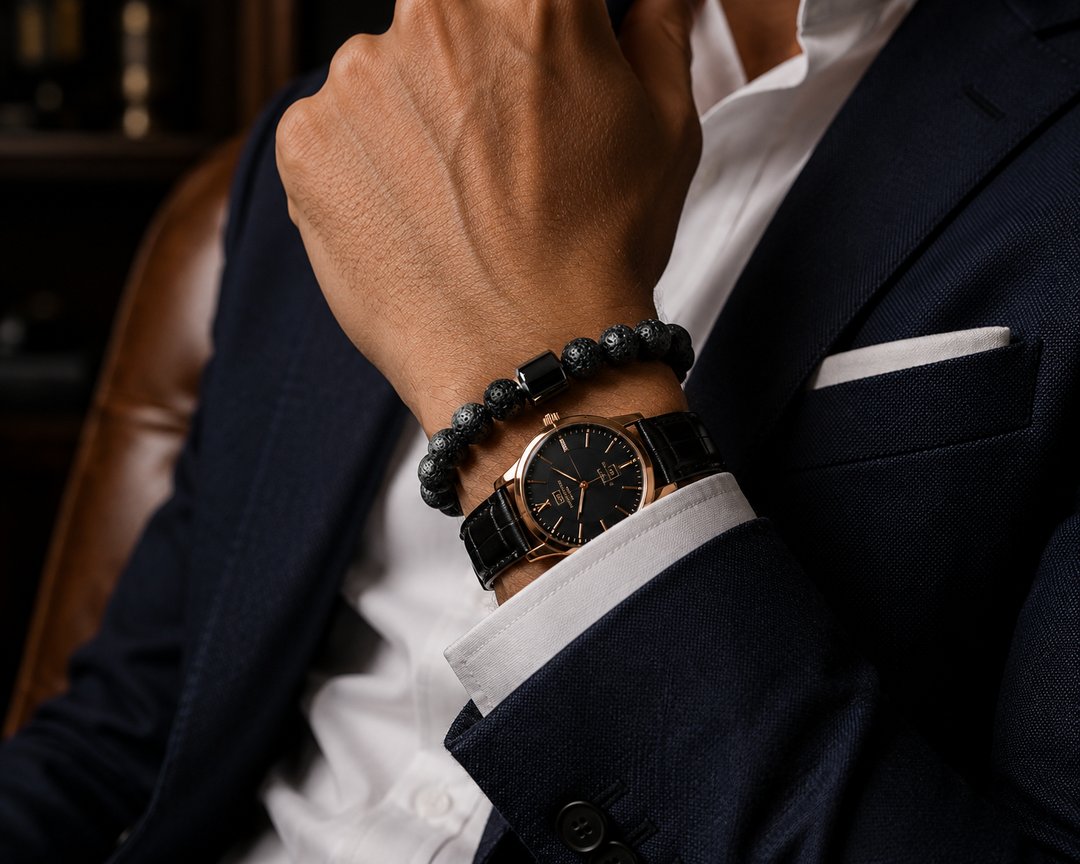
Men's Jewelry Etiquette for Work: What to Wear and What to Skip
Business formal rewards restraint. One watch, one ring, and one slim bracelet is plenty. Skip anything that jangles, clinks on the desk, or catches light across a conference table.
- Wear: a slim leather bracelet, a simple watch, a wedding band
- Skip: stacked cuffs, thick chains, loud beads, oversized pendants
- Watch out: a loose bracelet that slides over your hand looks careless in a meeting
If your office leans conservative, check the dress code before adding anything. For broader guidance, our men's accessories for work hub covers the full picture.
Business Casual Accessory Rules for Leather Bracelets
Business casual gives you more room. You can wear a slightly wider bracelet, add a second slim band, or introduce a natural stone piece. Keep the palette tight: two tones maximum.
A brown leather bracelet with a beaded bracelet in neutral stone works well with chinos and a blazer. Just do not let the wrist become the loudest part of the outfit.
Fit, Comfort, and Wearing a Bracelet Beneath a Shirt Cuff
Fit decides whether a bracelet looks sharp or sloppy, and under a dress shirt cuff it also decides whether you can get through a workday without thinking about your wrist. Most style guides stop at 'make sure it fits.' The practical version is more specific.
Measure before you buy. Wrap a soft measuring tape snugly around your wrist bone, just below the wrist joint, and note the circumference. Add roughly 0.5 inch for a close fit that stays put under a cuff, or 0.75 to 1 inch if you want a little movement or plan to stack. A bracelet listed by its total length should measure about 1 inch longer than your wrist circumference for a comfortable single-band fit. Our sizing guide walks through getting the measurement right.
Match the profile to the cuff. A dress shirt cuff typically has a circumference only slightly larger than your wrist, so a bracelet thicker than about 0.25 inch will bunch the fabric or push the cuff up your forearm. A slim strap, roughly the width of a watch strap, sits flat and either stays hidden or peeks out by a few millimeters, which is the intended look at business formal. A chunky cuff bracelet will not clear a fitted shirt cuff and should be saved for business casual or short sleeves.
Prevent snagging. The two snag points are the clasp and any exposed stitching on the inner face. A bracelet that catches on the shirt cuff will fray the fabric over time and pull the cuff out of place every time you reach across a desk.
Test it for a workday, not a mirror. Wear the bracelet for a full day at a desk before trusting it with a suit. A bracelet that leaves a red mark after an hour is too tight; one that slides over your hand when you gesture is too loose and looks careless in a meeting. The right fit stays in place when you type, shake hands, and reach for a coffee cup, and comes off without a struggle at the end of the day.
Watch out: sizing up to accommodate a stack can leave a single bracelet loose enough to slide under the cuff and bunch the fabric. If you plan to stack, size each band for the combined fit rather than buying one oversized bracelet.
A leather bracelet also needs occasional care to stay presentable.
Shop Leather Bracelets Built for the Office
Ready to add one to your rotation? Start with a single slim leather bracelet in black or brown, then match it to your belt and shoes.
I Look Classy offers top-grain leather and natural materials, with fast shipping from the USA and a 30-day return policy. Browse our bracelet collection to find office-ready options, or read our guide on how to style men's bracelets for more outfit ideas.
The difference between a sharp wrist detail and a distracting one comes down to fit, color, and restraint. I Look Classy makes that easy with premium top-grain leather, natural stone bracelets, and gift sets built for the modern professional, backed by fast shipping from the USA and a simple 30-day return policy. Get started with I Look Classy and finish every suit with a detail that looks deliberate.
Frequently Asked Questions
Is it professional to wear a leather bracelet with a business suit?
Yes, when the bracelet is slim, understated, and made of quality leather in a neutral color like black or brown. A single leather bracelet in a simple design reads as a refined detail rather than a distraction. Avoid thick cuffs, bright colors, and heavy hardware in formal settings. Match the leather to your belt or watch strap, and keep the bracelet tucked beneath your shirt cuff for a polished look.
How do you balance a watch and a leather bracelet on the same wrist?
Choose a slim leather bracelet that sits close to the skin and does not overlap the watch case. Wear the bracelet on the opposite wrist if your watch has a metal bracelet, or keep both on the same wrist only when the bracelet is thin and the watch strap is leather. The goal is visual balance: one accessory should not overpower the other.
What is the 2:1:1 rule for wearing jewelry?
The 2:1:1 rule is a simple guideline for men's jewelry: wear no more than two rings, one watch, and one bracelet at a time. It prevents your look from feeling cluttered. In a business setting, you can scale back further to one watch and one slim bracelet. The rule is not rigid, but it helps you keep accessories proportional and intentional.
How many bracelets should a man wear with a suit?
One bracelet is the safest choice with a suit. A single leather bracelet in a neutral color adds subtle detail without drawing attention away from your face and tailoring. If you want to stack, limit it to two slim bracelets of similar width and tone, and skip the stack for formal meetings or interviews. Business casual settings give you more room, but restraint still reads as confidence.
