

Buy Handcrafted Leather Wallets Online: 2026 Guide
Table of Contents
- What to Look for When You Buy Handcrafted Leather Wallets Online
- Full-Grain Leather Wallet vs Genuine Leather: What the Label Really Means
- Choosing a Slim Leather Wallet for Men: Sizing and Capacity Guide
- Personalized Leather Wallet for Men: Monograms, Debossing, and Gift-Ready Options
- Leather Wallet Care: Cleaning, Conditioning, and Expected Lifespan
- Where to Buy Handcrafted Leather Wallets Online: Shipping, Returns, and What to Check
- Conclusion
- Frequently Asked Questions
Last Updated: October 5, 2026
What to Look for When You Buy Handcrafted Leather Wallets Online
When you buy handcrafted leather wallets online, the product photos tell you less than you think. Most listings look identical at thumbnail size, so the real differences hide in the details: stitch density, edge finishing, and how the leather was tanned.
Start with the leather itself. A full-grain leather wallet keeps the hide's natural surface intact, which is why it develops a patina instead of peeling. Genuine leather is a legal catch-all term for the lower layers, and it behaves very differently over time.
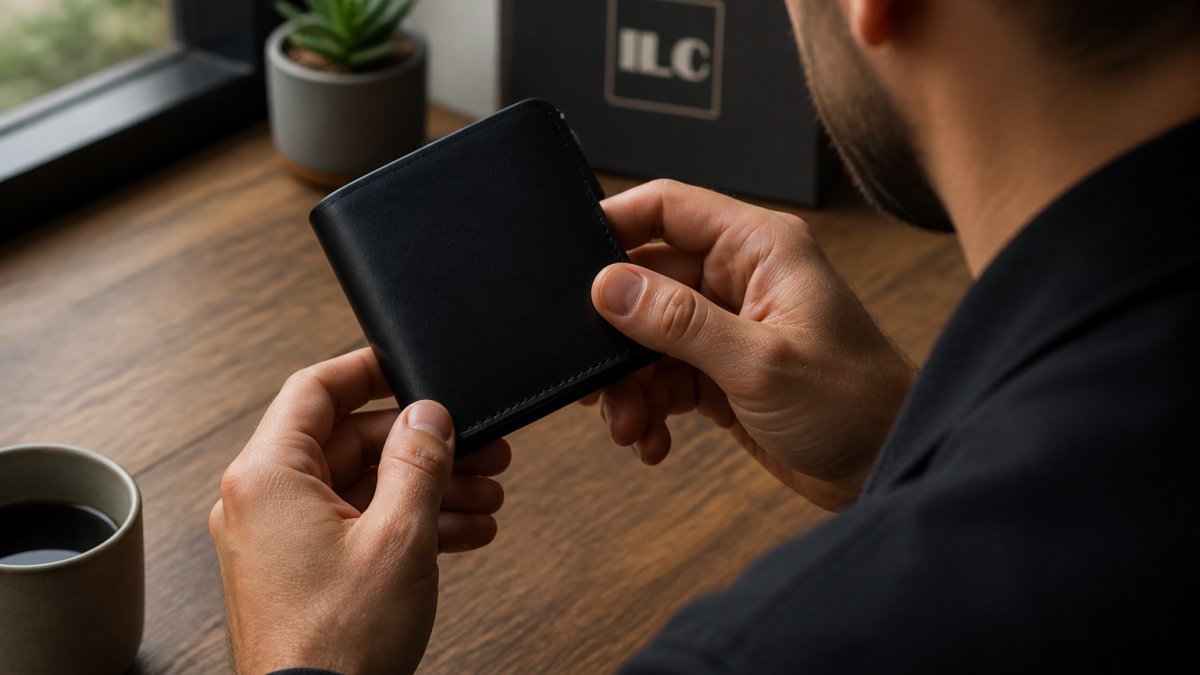
Stitching, Edges, and Hardware: The Handmade Construction Signals
Saddle stitching is the clearest marker of handcrafted construction. Two needles pass through each hole in opposite directions, so a broken thread stays put instead of unraveling the whole seam. Machine lockstitch, by contrast, can fail in a single pull.
Look for these signals in close-up photos:
- Even, slightly angled stitches with no gaps between them
- Burnished or painted edges rather than raw, fuzzy cuts
- Solid brass or zinc-alloy hardware, not thin plated metal
- Consistent thickness across the fold, which signals skiving was done properly
Full-Grain Leather Wallet vs Genuine Leather: What the Label Really Means
Full-grain leather is the outermost layer of the hide with the grain intact. It is the strongest part of the animal skin, and it ages rather than degrades. Genuine leather is a broad industry term that can describe split layers, bonded scraps, or heavily corrected hides. Top-grain leather sits between the two: the surface is lightly sanded to remove imperfections, which gives a more uniform look at the cost of some natural character.
That gap matters when you buy handcrafted leather wallets online. A full-grain piece will soften and darken with use. A corrected-grain or bonded piece tends to crack at the fold, usually within the first year of daily carry. Top-grain is still durable and is what we use in the ILC Signature Bifold Wallet, where the exterior is top-grain and the interior is lined with microfiber for structure.

A Transparent Buying Guide to Leather Grades
Most listings use the same handful of words, so it helps to know what each one actually promises:
| Label | What It Is | How It Ages | Typical Use |
|---|---|---|---|
| Full-grain | Whole hide, grain intact | Develops patina, darkens, softens | Heirloom wallets, belts |
| Top-grain | Grain lightly sanded | Uniform look, moderate patina | Everyday wallets |
| Corrected-grain | Heavy sanding plus finish | Resists marks, can crack at fold | Budget wallets |
| Genuine leather | Catch-all for split or bonded layers | Peels or cracks with heavy use | Promotional goods |
| Bonded leather | Scraps glued and pressed | Frays at edges, short life | Low-cost accessories |
A common pattern is that a wallet marketed only as "genuine leather" is a split or bonded product, while a maker proud of full-grain will say so in the first sentence. If the grade is not named, ask.
Vegetable-Tanned vs Chrome-Tanned: How Tanning Changes Aging and Feel
Vegetable-tanned leather is processed with plant tannins over weeks. It starts firm, takes on a deep patina, and is the traditional choice for handcrafted work. Chrome-tanned leather is processed in days with chromium salts, which makes it softer and more water-resistant out of the box.
Neither is automatically better. Vegetable-tanned leather suits buyers who want visible aging. Chrome-tanned leather suits buyers who want a soft wallet that holds its shape with minimal break-in. The Leather Working Group's tannery standards outline how responsible tanneries are audited, which is worth checking if sourcing matters to you.
Sourcing, Sustainability, and Repairability
Sourcing transparency is the part of the label most shoppers never see. A tannery audit tells you whether wastewater and chemical handling meet a recognized standard, but it does not tell you where the hide came from. Ask the maker two questions: which tannery finished the leather, and whether the wallet can be repaired rather than replaced. A repairable wallet with a named tannery is usually a better long-term buy than one with a vague "premium leather" claim.
Choosing a Slim Leather Wallet for Men: Sizing and Capacity Guide
A slim leather wallet for men should hold what you actually carry, not what you might carry someday. Most men overstuff a bifold, then blame the wallet for the bulge. The fix is to size the wallet to your real daily load, not to the maximum it could theoretically hold.
Here is how capacity maps to real daily carry:
| Wallet Style | Card Capacity | Best For | Pocket Fit |
|---|---|---|---|
| Card case | 3-5 cards | Minimalist carry, front pocket | Very slim |
| Slim bifold | 6-8 cards | Everyday carry with cash | Front or back |
| Standard bifold | 8-12 cards | Cards plus receipts and ID | Back pocket |
| Trifold | 10+ cards | Maximum storage, bulkier | Back pocket |
The ILC Slim Leather Bifold Wallet carries 7 cards plus a dedicated cash compartment, which covers most professional daily carry without adding bulk. If you routinely carry more than ten cards, a trifold makes more sense, but expect a thicker profile.
How to Choose by Card Count, Cash Use, and Pocket Placement
Start by counting what is actually in your wallet today, then subtract anything you have not used in a month. Most people find they carry three to five cards they never touch.
- Card count: Under five cards, a card case is enough. Five to eight, a slim bifold. Eight or more, a standard bifold or trifold.
- Cash use: If you still carry bills, look for a dedicated cash compartment rather than folding bills into a card slot, which stretches the leather.
- Pocket placement: Front-pocket carry favors card cases and slim bifolds. Back-pocket carry tolerates a standard bifold but punishes anything thicker.
- Bulk tolerance: A wallet that is comfortable in a jacket pocket is not the same as one that disappears in a front jeans pocket. Measure the pocket before you buy.
Why Bulk Matters More Than Style Labels
The style label on a listing tells you the fold, not the thickness. Two slim bifolds can differ by several millimeters depending on leather weight, lining, and how many card slots are stacked. A wallet that starts slim but has eight card slots will bulge once those slots are full.
ILC Slim Leather Bifold Wallet — 7 Card Slots →
A common pattern is that buyers upgrade to a larger wallet for capacity, then carry the same five cards and end up with a thicker, less comfortable object. Match the wallet to your real load, not your imagined one.
Personalized Leather Wallet for Men: Monograms, Debossing, and Gift-Ready Options
A personalized leather wallet for men turns a practical accessory into something he keeps. Debossing presses initials into the leather without ink, leaving a subtle impression that ages with the surface.
If you are buying for someone else, a gift set removes the guesswork. The ILC Top Grain Leather Black Classic Buckle Belt + Black Wallet Gift Set pairs a top-grain bifold with a matching belt in an ILC gift box and bag, and the 5-Piece Executive Men's Gift Set adds two belts and natural stone bracelets for a fuller presentation.

Leather Wallet Care: Cleaning, Conditioning, and Expected Lifespan
Leather wallet care comes down to three habits: keep it dry, condition it sparingly, and let it rest. A well-made full-grain wallet used daily typically lasts five to ten years before it needs repair, and many outlast that with basic upkeep.
The routine:
- Wipe with a dry cloth weekly to remove oils and grit
- Condition every three to six months with a leather balm, a small amount goes far
- Let a wet wallet air-dry away from direct heat, never on a radiator
- Store it loosely, not compressed under books
Over-conditioning is the mistake we see most. Excess balm clogs the grain, attracts dust, and leaves a sticky film. If the leather looks matte and feels dry at the fold, it needs conditioning. If it looks shiny, it does not.
Where to Buy Handcrafted Leather Wallets Online: Shipping, Returns, and What to Check
Buying online removes the one advantage a store has: handling the piece first. You replace that with policy checks, and the policies matter as much as the leather.
Before you buy handcrafted leather wallets online, confirm four things:
- Return window and who pays return shipping. A 30-day window with no-hassle returns removes most of the risk.
- Shipping origin and delivery estimate. Domestic shipping avoids customs delays and surprise fees.
- Customization terms. Personalized items are often final sale, so confirm before ordering.
- Warranty or repair policy. Reputable makers stand behind their stitching.
We ship from the USA and offer a simple 30-day return policy, so if the fit or the feel is not right, sending it back is straightforward. The Federal Trade Commission's online shopping guidance explains your rights on returns and delivery timelines, which is useful when a seller's policy is vague.
Conclusion
The hardest part of buying a leather wallet sight unseen is trusting that the leather is what the listing claims. Stitch density, edge finishing, and tanning method are the three details that separate a wallet you replace every year from one you carry for a decade.
At I Look Classy, we build around top-grain leather, gift-ready packaging, fast shipping from the USA, and a 30-day return policy, so you can judge the quality in your own hands. Start with the ILC Slim Leather Bifold Wallet at $49.99, or step up to an Executive Gift Set at $169.99 when the wallet is a gift.
Frequently Asked Questions
What should I look for when buying a handcrafted leather wallet?
Check three things: the leather grade, the stitching, and the interior lining. A handcrafted leather wallet should use full-grain or top-grain leather on the exterior, with even, tight stitching along the edges. Look for a durable interior lining rather than raw cardboard or paper. The ILC Signature Bifold Wallet, for example, pairs a top-grain leather exterior with microfiber lining and seven card slots, which covers the essentials for daily carry.
Is full-grain leather better for a wallet?
Full-grain leather keeps the outermost layer of the hide intact, so it ages into a patina instead of peeling. It resists cracking better than split or bonded leather because the fibers are still tightly packed. The trade-off is cost and stiffness at first; full-grain softens with use. Top-grain leather, which has the surface lightly sanded, offers a smoother finish and still holds up well for everyday carry.
How long should a quality leather wallet last?
A well-made full-grain or top-grain leather wallet typically lasts five to ten years with regular use. Lifespan depends on how often you sit on it, how many cards you stuff into it, and whether you condition the leather once or twice a year. Wallets kept in a front pocket and rotated occasionally tend to last longer than ones overloaded in a back pocket.
Are slim leather wallets practical for carrying cards and cash?
Yes, if you carry fewer than ten cards. A slim leather wallet for men usually holds four to eight cards plus a bill compartment. The ILC Signature Bifold Wallet fits seven cards and full-length bills in a profile that works in a front or back pocket. If you carry more than ten cards or a thick stack of receipts, a trifold or larger bifold may suit you better.
Do handcrafted leather wallets make good gifts?
They work well for birthdays, anniversaries, graduations, Father's Day, and corporate gifting because leather ages with the owner and stays in daily use. Gift sets that bundle a wallet with a matching belt, like the ILC Executive Leather Gift Set, arrive in presentation packaging and remove the guesswork of pairing accessories.