

Why Choose Full Grain Leather: A 2026 Guide
Table of Contents
- Why Full Grain Leather Is the Smartest Investment for Men Who Value Quality
- Full Grain vs Top Grain Leather: What's the Real Difference?
- How to Identify Authentic Full Grain Leather
- The Aging Process: How Full Grain Leather Develops a Patina
- Leather Care and Maintenance Tips for Long-Lasting Accessories
- Environmental Impact and Supply Chain Transparency in Leather Production
- Common Mistakes When Buying Full Grain Leather
- Conclusion: Why Full Grain Leather Belongs in Your Wardrobe
- Frequently Asked Questions
Last Updated: October 4, 2026
Why Full Grain Leather Is the Smartest Investment for Men Who Value Quality
Full grain leather is the strongest, most durable form of leather available, made from the outermost layer of the hide with its natural grain left completely intact. For men who want accessories that survive years of daily use, it outlasts almost everything else in the closet. At I Look Classy, we build our collection around premium top-grain leather precisely because the material decides how long a piece stays presentable. This guide explains why choose full grain leather over cheaper alternatives, how to spot the real thing, and how to keep it sharp for a decade or more.
Leather quality is decided at the tannery, not the checkout counter; the stitching, the buckle, and the price tag are secondary. Below, we break down the grading system, the patina process, and the mistakes that separate a lifelong accessory from a throwaway purchase.
Full Grain vs Top Grain Leather: What's the Real Difference?
Full grain leather keeps the entire top layer of the hide, while top grain leather has that surface sanded away to remove imperfections. That single step changes everything about how a piece ages.
The difference comes down to fiber density: the outermost layer holds the tightest, most interlocked fibers, so full grain resists stretching, cracking, and moisture far better than sanded alternatives. Top grain remains a genuinely good material, and it is what we use across much of our collection. Corrected grain and genuine leather sit further down the ladder, with genuine leather often a vague marketing term for lower-quality splits.
Leather manufacturing and material guidance
How the Leather Grading System Actually Works
The leather grading system ranks hides by how much of the natural surface is left intact, not by an official industry standard. No universal governing body certifies a "grade," which is exactly why the term gets abused in marketing.
- Full grain: Entire grain surface intact, no sanding, highest fiber density
- Top grain: Surface lightly sanded to remove scars and marks
- Corrected grain: Heavily buffed and embossed with a fake pattern
- Split leather: Inner layer of the hide, no natural grain at all
- Bonded leather: Scraps glued and pressed together, the weakest option
The leather grade myth is that higher price always means higher grade. It doesn't. Plenty of expensive belts are corrected grain with a premium markup.
How to Identify Authentic Full Grain Leather
Authentic full grain leather shows visible natural markings, a soft uneven surface, and an earthy rather than chemical smell. If the surface looks perfectly uniform and plastic-smooth, it is almost certainly corrected or bonded leather.
Start with the surface, not the label. Full grain keeps the outermost layer of the hide, so the grain pattern is irregular and never repeats. Look for fine pores, faint scars, insect marks, and slight color variation.
Check the edge. This is the single most reliable tell and the one most buyers skip. Full grain edges show tight, fibrous layers running through the full thickness.
Press and release. Run your thumb across the surface and press gently. Real full grain flexes and springs back with fine wrinkles radiating from the pressure point.
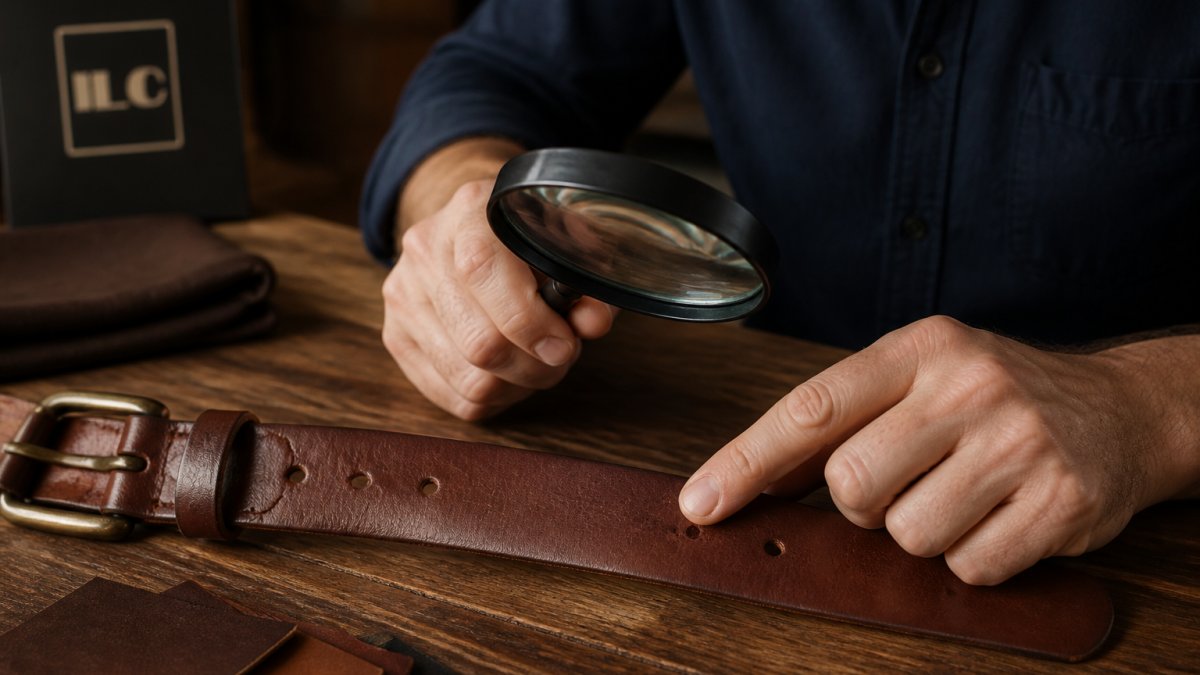
Tactile and Sensory Identification: What Your Hands Can Tell You
Your hands detect quality faster than any label. Here is how to translate what you feel into a verdict.
Temperature and weight. Full grain leather feels dense and slightly cool against your palm, then warms quickly because the tight fiber structure conducts your body heat.
Surface friction. Drag a fingertip slowly across the grain. Full grain has a subtle, almost waxy drag, natural oils and open pores create resistance. Corrected grain feels slick and rubbery, like a coated synthetic.
The flex test. Fold the leather gently against itself. Full grain wrinkles in fine, irregular lines that fan out from the fold. Corrected grain creases in a few sharp lines or cracks along the coating.
The smell test. Real full grain leather smells earthy, slightly sweet, and animalic, a tanned-hide smell that lingers. Chrome-tanned leather often carries a faint metallic or chemical note.
The grain-repeat check. Embossed patterns repeat on a fixed interval because they come from a roller or plate. Natural grain never repeats.
What this means for online buying. Since you cannot run the flex or smell test through a screen, ask the seller for three photos: a raking-light close-up of the grain, a straight-on shot of a cut edge, and the item folded or rolled. Sellers of genuine full grain can produce these in minutes. Sellers of corrected grain usually cannot, or they send studio-lit images that hide the texture. That refusal is itself an answer.
The Aging Process: How Full Grain Leather Develops a Patina
Patina is the deep, uneven sheen that develops as oils from your skin, sunlight, and daily friction work into the grain over time. It is the biggest reason full grain leather looks better in year five than on day one.
Cheaper leathers cannot develop patina because their surface has been sanded, coated, or glued; they simply wear out, cracking and peeling at the flex points. Full grain absorbs and responds, darkening where you touch it most: the belt loop you reach for, the wallet corner you pull from your pocket. That process is unique to each owner, so no two pieces age the same way.
Leather Care and Maintenance Tips for Long-Lasting Accessories
Leather care and maintenance tips are simpler than most people expect: keep it dry, condition it sparingly, and let it rest. Overconditioning is the most common mistake and clogs the grain.
- Wipe with a dry cloth after exposure to moisture, never a heat source
- Condition every three to six months with a small amount of leather balm
- Store belts rolled, not hung, to prevent stretching
- Keep wallets out of direct sunlight for extended periods
- Address scuffs early with a fingertip of conditioner before they dry out
A common mistake is treating leather like fabric and washing it. Water and detergent strip the natural oils that keep fibers supple, accelerating cracking. If a piece gets soaked, let it dry at room temperature, away from radiators and direct sun.
Environmental Impact and Supply Chain Transparency in Leather Production
Leather's environmental footprint depends heavily on the tanning method. Tanning stabilizes the hide so it does not rot, and the chemistry used there drives most of the environmental difference between one full grain belt and another.
The two main tanning routes. Chrome tanning uses chromium salts and finishes a hide in about a day; it is fast, cheap, and produces the soft, uniform leather most consumers know. Vegetable tanning uses plant-derived tannins, traditionally tree bark, quebracho, and mimosa extracts, and can take weeks to months.
Why the tannery, not the label, is the deciding factor. A full grain hide from a well-run tannery carries tighter fiber structure and fewer chemical shortcuts than a rushed, heavily corrected one.
What to look for when vetting a source.
- A named tannery. If the brand cannot tell you which tannery produced the hide, they likely do not know. Reputable makers usually name their tannery the way a roaster names a farm.
- A tanning method. "Vegetable-tanned" or "chrome-tanned" is a specific, verifiable claim. "Eco-friendly leather" is not.
- Certifications tied to a specific facility. Third-party audit programs exist for tanneries, and a legitimate claim can usually be traced to a facility name and audit date. A logo with no facility behind it is decoration.
- Wastewater and effluent handling. Tanning generates significant wastewater. Facilities that treat and recycle process water have a materially different footprint than those that do not, and this is often disclosed in a tannery's own environmental reporting.
EPA guidance on pollution prevention in leather tanning
The durability argument is also an environmental argument. A full grain belt or wallet that lasts a decade replaces roughly ten to twenty cheap corrected-grain items over the same period. Even if the full grain item carries a higher upfront footprint per unit, the per-year impact is usually lower because it is not thrown away and remanufactured every season.
A practical buying rule. Ask two questions before you buy: which tannery made this hide, and how was it tanned? Clear answers mean a transparent supply chain. A marketing phrase instead of a facility and a method means the environmental claim is unproven, judge the item on its grain, edge, and construction instead.
Common Mistakes When Buying Full Grain Leather
The biggest mistake is trusting the label instead of the surface. Many products advertised as full grain are top grain or corrected grain, and "genuine" on a tag means almost nothing.
- Assuming price equals grade, when corrected grain often carries a premium markup
- Ignoring the edge finish, which reveals the true construction
- Buying based on a photo, where lighting hides surface coatings
- Skipping the smell test, since real leather smells earthy, not chemical
- Overlooking stitching quality, which fails before the leather does
| Mistake | What It Costs You | The Fix |
|---|---|---|
| Trusting the label | Buying corrected grain at full grain prices | Inspect the surface and edges in person |
| Judging by photo | Missing coatings hidden by studio lighting | Ask for close-up grain shots |
| Ignoring edges | Missing signs of split or bonded leather | Check for tight fibrous layers |
| Skipping the smell | Overlooking chemical-treated hides | Trust an earthy, natural scent |
| Overlooking stitching | Premature failure at the seams | Check for even, tight stitching |
A second mistake is buying leather goods as disposable. Treated well, a full grain belt or wallet can last a decade, making the upfront cost far lower per year than replacing a cheap one every season.
Conclusion: Why Full Grain Leather Belongs in Your Wardrobe
Choosing full grain leather is a decision about time, not just money. The material rewards you with patina, resists the wear that destroys cheaper hides, and stays presentable through years of daily use. At I Look Classy, we built our collection around premium materials, fast shipping from the USA, and a simple 30-day return policy so you can invest with confidence. Explore our belts, wallets, and Executive Gift Sets, and give your wardrobe an accessory that gets better every year you wear it.
Frequently Asked Questions
Is full grain leather worth the extra cost?
Yes. Full grain leather keeps the hide's natural fiber structure intact, so it resists cracking and peeling far longer than corrected or bonded leather. Over years of daily use, it develops a rich patina instead of wearing out. The upfront price is higher, but the cost per year of wear is often lower than replacing cheaper belts or wallets every few months.
How can you tell if leather is full grain?
Look for visible natural markings like scars, wrinkles, and variations in grain. Run your finger across the surface: full grain feels slightly rough and uneven, not perfectly smooth. Check the edge for fiber density. If the surface looks uniform and plastic-like, it's likely corrected grain or top grain with a finish. Full grain also darkens and softens with use, while lower grades stay stiff.
Does full grain leather crack over time?
No. Because full grain leather retains the hide's dense, interwoven fibers, it flexes without breaking. Cracking happens when the surface layer is sanded away or replaced with a plastic coating, which is common in corrected grain and bonded leather. With basic care like occasional conditioning and keeping it dry, full grain leather can last decades without cracking.
What is the difference between full grain and top grain leather?
Full grain uses the entire hide surface, including natural markings and the strongest fiber layer. Top grain has the outermost layer sanded or buffed away to remove imperfections, leaving a more uniform but thinner surface. Full grain is more durable, breathable, and develops a patina; top grain is softer and more uniform but less resistant to wear over time.