

Men's Style Tips for Professionals: 2026 Guide
Table of Contents
- Why Fit and Tailoring Matter More Than Price
- Build an Essential Capsule Wardrobe for Men
- Business Casual Attire for Men: Dress Code Decoded
- How to Accessorize a Professional Outfit
- Choose Belts and Wallets That Last: What to Look For
- Dress for Your Body Type and the Hybrid Workweek
- Frequently Asked Questions
Last Updated: September 30, 2026
Why Fit and Tailoring Matter More Than Price
In men's style, a well-fitted jacket from a mid-range brand will always look better than a designer piece that pulls at the shoulders or bunches at the waist. This is the single most important men's style tip for professionals: fit beats price every time. At I Look Classy, we see this constantly in how a simple belt or wallet transforms an outfit when the proportions are right.
How a Professional Suit Should Fit
The jacket should close cleanly with one button, showing no pull across the chest. Sleeves should end at the wrist bone, letting a quarter inch of shirt cuff show. Trousers should rest on the shoe with a slight break, not a puddle of fabric.
Build an Essential Capsule Wardrobe for Men
An essential capsule wardrobe for men is a small, coordinated set of pieces that mix and match to cover nearly every professional situation. A capsule wardrobe usually runs 25 to 40 items, and every piece should work with at least three others. The goal is not minimalism for its own sake, it is a lower cost per wear, because every item earns its place on your back multiple times a month.
Tier 1: The Foundation (Months 1-3)
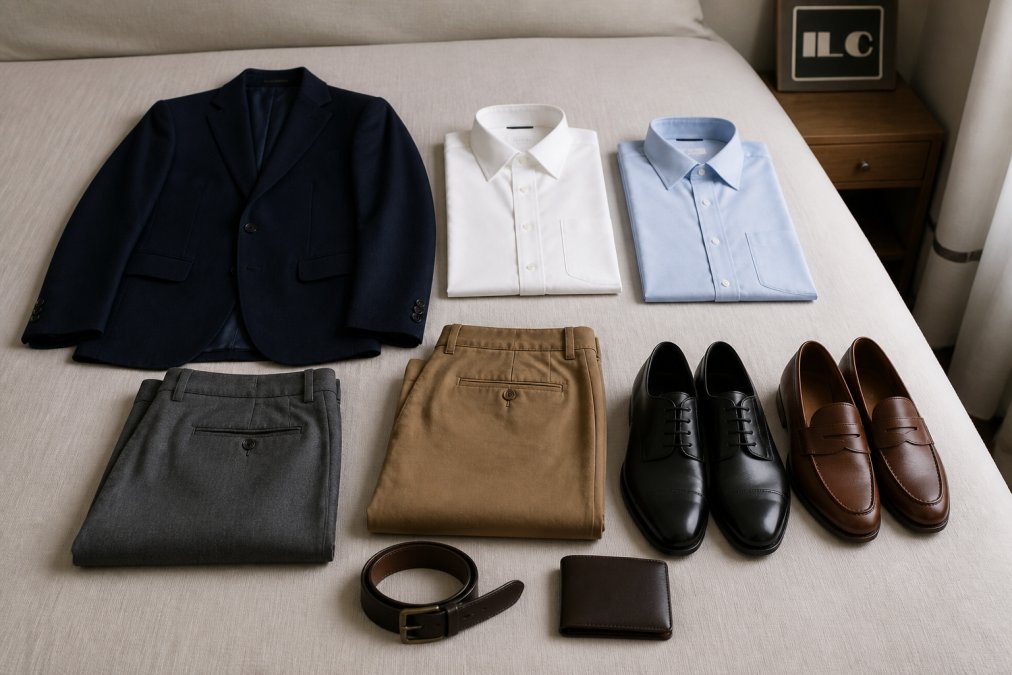
Start with the pieces you wear most often. Two suits, one navy and one charcoal, in a mid-weight wool or wool-blend. Add five button-up shirts in white and light blue, poplin for summer, oxford cloth for cooler months. Then four pairs of trousers: two wool dress pants and two chinos in navy or gray.
Tier 2: The Layer (Months 4-9)
Add two blazers, one navy, one textured (a subtle check or herringbone). Add one pair of brown leather oxfords and one pair of loafers. This is where you start rotating shoes so each pair gets 48 hours to dry between wears, which roughly doubles their lifespan.
Tier 3: The Refinement (Months 10-18)
Upgrade the pieces you wear hardest. Replace the Tier 1 shirts with two-ply cotton versions. Add a seasonal overcoat, a wool topcoat in charcoal or camel covers both suits and business casual. Add one pair of dark brown derbies for variety.
The 3-3-3 Rule for Getting Dressed
The 3-3-3 Rule keeps decision fatigue out of your morning. Pick three colors, three textures, and three focal points, then stop.
- Three colors: one dominant, one secondary, one accent
- Three textures: for example, wool trousers, a cotton shirt, and a leather belt
- Three focal points: watch, belt, and shoes, working together
Fabric and Construction Cheat Sheet
- Suits: mid-weight wool (around 9-11 oz) works year-round; avoid polyester blends above 30% if you can
- Shirts: two-ply cotton resists wrinkling and holds collar shape longer than single-ply
- Trousers: wool for dress, cotton twill for chinos; check that the waistband has a curtain or split-back for alteration room
- Shoes: Goodyear-welted or Blake-stitched soles can be resoled; glued soles cannot
Business Casual Attire for Men: Dress Code Decoded
Business casual attire for men means polished but relaxed: no tie required, but no gym clothes either. The safe formula is a collared shirt, tailored trousers or dark chinos, and leather shoes.
| Dress Code | Jacket | Shirt | Footwear | Tie |
|---|---|---|---|---|
| Business Professional | Suit required | Dress shirt | Oxfords or loafers | Yes |
| Business Casual | Optional blazer | Button-up or polo | Loafers or derbies | No |
| Smart Casual | Blazer or knit | Button-up or fine tee | Clean leather sneakers | No |
How to Accessorize a Professional Outfit
Accessories should finish an outfit, not compete with it. The rule is simple: pick two or three pieces and let the rest of your look breathe.
Matching Metals and Leathers
Match your metals to each other and your leathers to each other. If your watch is silver, your belt buckle and cufflinks should be silver too. If your shoes are brown leather, your belt should be brown leather in a similar tone.
Choose Belts and Wallets That Last: What to Look For
Durability comes down to materials and construction, not logos. Top-grain leather, a solid buckle, and clean stitching are the three signals that a belt or wallet will survive years of daily wear.
ILC 5-Piece Executive Men’s Gift Set™ →
Here is what to check before you buy:
- Leather type: Top-grain leather holds up far better than bonded or "genuine" leather splits
- Buckle material: Zinc alloy or solid brass resists bending and tarnishing
- Stitching: Tight, even stitching means the piece was built to last
- Edge finish: Burnished or painted edges resist fraying
- Adjustment system: A ratchet track avoids the hole-stretch problem of traditional belts
Dress for Your Body Type and the Hybrid Workweek
Your body type should shape your choices, not limit them. Taller men can carry wider lapels and longer jackets. Shorter men look sharper in slimmer cuts and higher trouser rises. Broader builds benefit from structured shoulders and single-breasted jackets.
Body Type Fit Rules
- Tall (6'1" and up): wider lapels (3.5-4 inches), longer jacket hem, and a trouser break that covers the ankle. Avoid cropped cuts, which exaggerate height.
- Shorter (under 5'8"): slimmer lapels (2.5-3 inches), higher trouser rise, and a jacket hem that ends at the top of the thigh. Monochrome outfits elongate the line.
- Athletic or broad-shouldered: structured shoulders, single-breasted jackets, and a slight taper at the waist. Avoid double-breasted cuts unless tailored aggressively.
- Slim or narrow-shouldered: soft-shouldered jackets with a bit of padding, textured fabrics (tweed, flannel) that add visual weight, and layering with knitwear.
The Two-Setting Wardrobe
The hybrid professional needs pieces that work in both environments. The trick is to build around a core that reads well on camera and in person, then adjust the outer layer.
- Video calls: focus on the shirt collar, a clean neckline, and one simple accessory. Solid colors, white, light blue, navy, read best on camera; tight patterns like small checks and thin stripes cause shimmer on most webcams. A stone bracelet or a simple watch adds a focal point without distracting.
- Office days: full business casual, with a blazer ready to grab. A navy or charcoal blazer over the same shirt you wore on the call instantly upgrades the look.
- Transition pieces: chinos, loafers, and a versatile belt that works with both denim and dress trousers. A ratchet belt is especially useful here because you can adjust the fit when you tuck versus untuck a shirt.
The Camera-Ready Checklist
Before your next video call, run this quick check:
- Collar: stands up on its own; no gaping at the neck
- Color: solid or very subtle texture; avoid pure white against a white wall
- Shoulders: jacket or shirt seam sits at the edge of your shoulder, not past it
- Accessories: one focal point, watch or bracelet, not both competing
- Background: neutral; your outfit should be the most interesting thing on screen
Packing for the Hybrid Week
If you commute or travel between home and office, keep a small kit at your desk: a lint roller, a spare belt, and a travel steamer. Wrinkles show up more on camera than in person, and a two-minute steam before a call does more than an hour of ironing the night before.
Frequently Asked Questions
What is the 3-3-3 rule for men's fashion?
The 3-3-3 rule is a simple guideline for building a professional look: limit your outfit to three colors, three distinct textures, and three visible accessories. For example, a navy blazer, white shirt, and gray trousers cover the color limit; wool, cotton, and leather add texture; a belt, watch, and leather shoes complete the accessories. This keeps your outfit cohesive without looking busy. It also makes packing and shopping easier because you can mix and match pieces that already follow the same formula.
How do you build a capsule wardrobe for work?
Start with a wardrobe inventory. Pull out everything you own and separate what fits well and gets worn from what does not. Then fill gaps with versatile staples: two pairs of trousers (one navy, one gray), three button-up shirts, a blazer, two belts (black and brown), and a slim bifold wallet. Choose neutral colors so pieces work together. Add layers like a merino sweater for cooler months. A capsule wardrobe for men works best when every item can pair with at least three others, which cuts decision time and keeps your professional image consistent.
What is the difference between business professional and business casual?
Business professional typically means a suit and tie, leather dress shoes, and a formal belt. Business casual is more relaxed: chinos or dress pants with a button-up shirt or polo, no tie required, and leather loafers or oxfords. The key difference is structure and formality. A business professional outfit usually includes a matching jacket and trousers, while business casual allows separates. When in doubt, check your office dress code. In many workplaces, a blazer over chinos works for both settings and keeps you looking polished.
How should a professional suit fit?
A professional suit should fit close to the body without pulling. The jacket shoulders should end at your natural shoulder line, and the sleeve should show about half an inch of shirt cuff. The jacket should button comfortably without straining across the chest. Trousers should sit at your waist, not your hips, with a slight break at the shoe. A tailor can adjust sleeve length, waist, and hem for a modest cost. Good fit matters more than price because an ill-fitting expensive suit looks worse than a well-tailored affordable one.
What are the essential accessories for a professional wardrobe?
The essentials are a leather belt that matches your shoes, a slim bifold wallet, a watch with a leather or metal band, and optionally a natural stone bracelet for a modern touch. A top-grain leather belt and wallet set, like the ILC Executive Gift Set, covers the core pieces at $84.99. Choose belts in black and brown so you always have a match. Keep accessories understated: one or two visible pieces are enough. Quality leather goods last longer and look better than synthetic alternatives, so they are worth the investment.
Building a professional wardrobe is less about buying more and more about choosing well. I Look Classy makes that easier with top-grain leather belts, slim bifold wallets, natural stone bracelets, and curated Executive Gift Sets, all backed by fast shipping from the USA and a simple 30-day return policy. Get started with I Look Classy and build a wardrobe that projects confidence in every detail.