

Leather Wallet Maintenance Tips 2026: A Complete Care Guide
Last Updated: October 23, 2026
Quick Summary
Good leather wallet maintenance means cleaning with mild soap and a barely damp cloth every two to three months, then applying a pH-balanced conditioner once fully dry. Match the routine to your leather type, since full-grain, top-grain and bonded leather need different care.
- Move your wallet to a front pocket or bag instead of sitting on it in a back pocket.
- Deep clean your wallet every two to three months, or sooner if it looks dull or feels tacky.
- Condition every 6 to 8 weeks in winter, when dry indoor air pulls oils from leather.
- Blot ink immediately and dab with 70% isopropyl alcohol, but never use alcohol on bonded leather.
- Air dry a soaked wallet for 24 to 48 hours away from heat before conditioning it.
Table of Contents
- Why Leather Wallet Maintenance Matters in 2026
- Your Leather Wallet Maintenance Routine: Daily Habits That Prevent Damage
- How to Deep Clean a Leather Wallet Without Harsh Chemicals
- The Best Leather Conditioner for Wallets (and How Often to Apply It)
- How to Remove Stains from a Leather Wallet: Ink, Oil, and Water Marks
- How Long Does a Leather Wallet Last? Lifespan by Leather Type
- Drying, Storing, and Seasonal Maintenance for Long-Term Durability
- Frequently Asked Questions
Why Leather Wallet Maintenance Matters in 2026
A leather wallet is one of the few accessories you touch every day, yet most men never clean or condition it, then wonder why it cracks within two years.
Good leather wallet maintenance is simple. It takes minutes a month.
Here is what most guides get wrong: they treat all leather the same. A full-grain wallet and a bonded leather wallet need very different care.
Your Leather Wallet Maintenance Routine: Daily Habits That Prevent Damage
The best defense against damage is a few small daily habits that take seconds.
Start with where your wallet lives. A back pocket gets sat on all day, flattening the leather and stressing seams.
Next, keep surface debris off it.
Here is a simple daily and weekly routine:
- Empty your wallet of receipts and loose change weekly
- Wipe the exterior with a dry microfiber cloth
- Keep it away from keys and coins that scratch the surface
A common mistake is stuffing a wallet until it bulges. That stretch is permanent and the fastest way to wear out a good bifold.
How to Deep Clean a Leather Wallet Without Harsh Chemicals
Deep cleaning a leather wallet means removing built-up dirt and oils with mild soap and a damp cloth, then air drying fully. Harsh chemicals strip natural oils and cause cracking, skip them entirely.
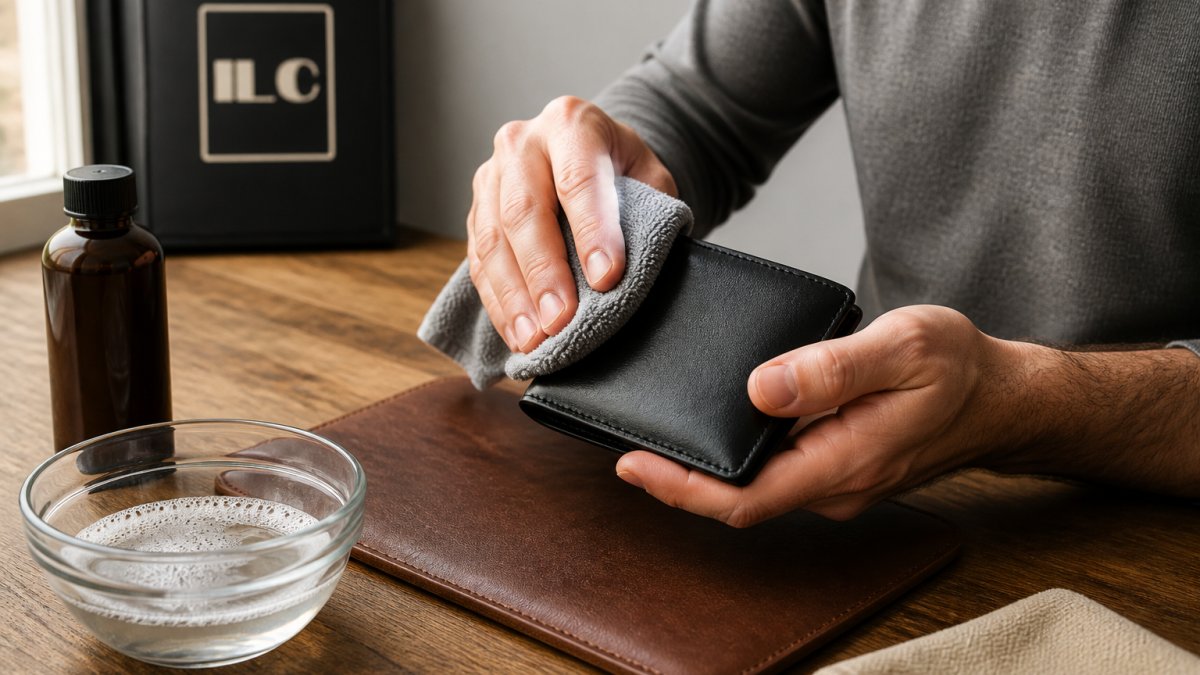
Clean your wallet every two to three months, or sooner if it looks dull or feels tacky.
Step-by-Step: Cleaning with Mild Soap and a Damp Cloth
Follow these steps for a safe, effective clean:
- Empty the wallet completely and brush off loose debris.
- Mix a few drops of mild soap into a bowl of warm water.
- Dip a microfiber cloth, wring it out until barely damp, and wipe the surface.
- Work in small circles, paying attention to edges and folds.
- Wipe away soap residue with a clean, damp cloth.
- Let it air dry away from direct sunlight and any heat source.
- Apply a pH-balanced leather conditioner once fully dry.
The key is a barely damp cloth, too much water is a common cause of water damage and stiffening.
Eco-Friendly and Natural Cleaning Alternatives
If you prefer natural options, diluted mild soap and water is safest; some use a little white vinegar mixed with water for light cleaning. Always test on a hidden area first.
Avoid homemade remedies with strong acids or abrasives, they strip the finish and dull the grain.
The Best Leather Conditioner for Wallets (and How Often to Apply It)
The best leather conditioner for wallets is a pH-balanced formula for smooth leather, applied every two to three months after cleaning. It replaces the natural oils that keep leather supple and prevent cracking.
Frequency depends on use and climate: a wallet carried daily in a dry climate needs it more often; one used occasionally needs it less.
How to apply it correctly:
- Use a small amount on a clean cloth
- Work it into the leather in thin, even layers
- Let it absorb for a few minutes
Over-conditioning is a real problem: too much product leaves a sticky residue that attracts dirt. A thin coat beats a heavy one.
For a wallet you plan to keep for years, start with quality leather. Our ILC Men's Top-Grain Leather Bifold Wallet uses a top-grain leather exterior with a microfiber interior, which holds up well to a regular care routine.
ILC Men’s Top-Grain Leather Bifold Wallet →

How to Remove Stains from a Leather Wallet: Ink, Oil, and Water Marks
Most wallet care guides stop at one sentence per stain. The right method depends on the stain, its freshness, and the leather type. Treat each differently, blot rather than rub, and always test on a hidden area first.
Ink Stains
Ink is the most time-sensitive stain. Fresh ink sits on the surface; ink left overnight can wick into the grain and become permanent.
- Blot immediately with a dry cloth, do not wipe, which spreads the ink.
- Dampen a cotton swab with isopropyl rubbing alcohol (70% concentration is standard) and dab only the stain.
- Work from the outside of the stain inward so you do not enlarge it.
On bonded leather, skip alcohol entirely, it can dissolve the polyurethane coating and cause peeling.
Oil and Grease Stains
Oil stains darken leather and spread if rubbed. The goal is to draw the oil out, not scrub it off.
- Blot excess oil with a dry cloth without pressing it deeper.
- Cover the stain with a thin layer of cornstarch or talcum powder.
- Let it sit for at least 4 hours, ideally overnight, so the powder absorbs the oil.
Oil stains often look worse before they look better; the dark patch usually fades over several days as the oil dissipates. Do not over-condition to hide it, that adds more oil.
Water Marks and Water Damage
Water marks form when a small area gets wet and dries unevenly, leaving a tide line. The fix is to wet the whole panel evenly so it dries uniformly.
- Dampen a microfiber cloth and wring it until barely damp.
- Wipe the entire panel, not just the mark, so moisture is even.
- Let it air dry at room temperature, away from heat and sunlight.
If the wallet was soaked, blot it, stuff it lightly with tissue to hold shape, and let it dry for 24-48 hours. Never use a hair dryer or radiator, heat sets cracks that cannot be reversed.
Leather-Type Cheat Sheet for Stain Removal
| Leather Type | Ink | Oil | Water Marks |
|---|---|---|---|
| Full-grain | Alcohol dab, then condition | Cornstarch overnight | Even damp wipe, air dry |
| Top-grain | Alcohol dab quickly, condition | Cornstarch, repeat | Even damp wipe, condition |
| Bonded leather | Avoid alcohol; blot only | Cornstarch, light | Blot, air dry, no heat |
| Suede/nubuck | Professional care | Cornstarch, brush | Suede brush once dry |
For deeper technical guidance on leather chemistry and care, the leather care guidance from the American Leather Chemists Association is a useful reference.
How Long Does a Leather Wallet Last? Lifespan by Leather Type
A well-cared-for leather wallet can last from two years to well over a decade, depending on leather type and treatment. The leather sets the ceiling; your routine decides whether you reach it.
Here is how the main leather types compare:
| Leather Type | Typical Lifespan | Care Needs |
|---|---|---|
| Full-grain | Longest, often 10+ years | Condition regularly, clean gently |
| Top-grain | Long, often 5-10 years | Condition every 2-3 months |
| Bonded leather | Shortest, often 1-2 years | Minimal care, limited durability |
Top-grain develops a patina and grows more supple with care.
Matching Your Care Routine to Full-Grain, Top-Grain, and Bonded Leather
Top-grain leather is sanded slightly for a smoother finish. It needs the same conditioning schedule but shows water marks more easily, so keep it dry.
Drying, Storing, and Seasonal Maintenance for Long-Term Durability
Most guides treat drying and storage as an afterthought. In practice, water and heat are the biggest causes of wallet damage, with seasonal humidity swings third. Here is how 2026 climate patterns affect storage.
Drying After Water Exposure
- Blot the surface with a dry microfiber cloth, do not rub.
- Stuff the wallet lightly with tissue or acid-free paper to hold its shape as it dries.
- Air dry at room temperature, away from direct sunlight, radiators, and hair dryers.
Heat dries out natural oils and causes irreversible cracking, and direct sunlight fades dyed finishes, especially on black and dark brown wallets. Never condition a damp wallet, wait until fully dry or the conditioner traps moisture.
Storing Your Wallet
- Store in a cool, dry place away from direct sunlight.
- Keep it out of damp drawers and off concrete floors, which wick moisture.
- Stuff lightly with tissue to hold shape; do not fold under weight.
Seasonal Maintenance: The 2026 Angle
Leather responds to humidity and temperature. Indoor heating and air conditioning create drier winter air and more humid summers, and both affect leather.
- Winter (low humidity, indoor heat): Condition every 6-8 weeks instead of every 2-3 months. Dry indoor air pulls oils from leather and accelerates cracking, especially on full-grain and top-grain.
- Summer (high humidity): Watch for mold and mildew. Let the wallet air out weekly, avoid storing it in a hot car, and wipe with a dry cloth after heavy sweat exposure. Skip heavy conditioning in peak humidity, a thin coat is enough.
- Rainy season: Dry the wallet fully before storage. A wallet stored damp develops mildew odor and finish damage within days.
A maintenance schedule that works for most men:
- Weekly: wipe with a dry cloth, clear out receipts
- Every 2-3 months: deep clean and condition (every 6-8 weeks in winter)
- Seasonally: check for dryness, cracks, water marks, and mildew
For a coordinated set, our ILC Top Grain Leather Black Classic Buckle Belt & Black Wallet Gift Set pairs a top-grain leather belt with a bifold wallet in gift packaging, a practical option for men who want quality pieces that hold up to a regular care routine.

Frequently Asked Questions
How often should I apply leather conditioner to my wallet?
Condition your wallet every three to six months under normal use, and more often if it sees daily pocket friction, heat, or dry winter air. A thin layer of conditioner worked in with a microfiber cloth is enough; excess product attracts dust and leaves a greasy feel. If the leather looks dull, feels stiff, or shows fine surface lines, it is asking for hydration sooner. Conditioning frequency also depends on leather type: top-grain absorbs conditioner well.
Can I dry my leather wallet in the dryer or with a hair dryer?
No. Heat from a dryer, hair dryer, radiator, or direct sunlight pulls moisture out of the leather too fast and causes cracking, shrinkage, and a stiff, brittle feel. After water exposure, empty the wallet, blot it with a dry microfiber cloth, and let it air dry at room temperature away from any heat source. Stuffing it lightly with paper helps it hold shape. A wallet typically needs 12 to 24 hours to dry fully, so give it a day before you load it back up.
How long does a leather wallet last with proper maintenance?
A well-cared-for top-grain leather wallet commonly lasts five to ten years or more. Lifespan depends on how full you stuff the wallet, and how consistently you clean and condition it. Rotating cards, avoiding overstuffing, and keeping the wallet away from heat and moisture all extend durability. A quality top-grain bifold cared for on a simple maintenance schedule can develop a rich patina instead of falling apart.
What are the best natural products for leather maintenance?
For cleaning, a pH-balanced saddle soap or a few drops of mild soap in distilled water works well. For conditioning, look for products built on natural oils such as lanolin, beeswax, or neatsfoot oil rather than petroleum-heavy formulas. Always test any product on a hidden area first, apply sparingly, and buff off the excess with a microfiber cloth. Avoid vinegar, rubbing alcohol, and household cleaners, which strip natural oils and cause chemical damage over time.
