

How to Identify Durable Top Grain Leather: 2026 Guide
Table of Contents
- What Top Grain Leather Actually Is (and What the Label Hides
- Top Grain vs. Full Grain Leather: One Letter, Two Different Hides
-
How to Tell If Leather Is Real: A 7-Step Inspection Checklist
- Step 1: Read the Label for Grade, Layer, and Origin
- Step 2: Examine the Grain Under Raking Light
- Step 3: Inspect the Edges
- Step 4: Turn It Over and Read the Backing
- Step 5: Press and Release the Surface
- Step 6: Smell It
- Step 7: Check the Construction at Stress Points
- What the Checklist Cannot Tell You
- Telling Top Grain Apart from Corrected Grain, Split, Bonded, and Synthetic Lookalikes
- What Top-Grain Leather Quality Looks Like in a Finished Belt or Wallet
- Durability by Use Case: Belts, Wallets, and Daily Wear
- How to Care for Top-Grain Leather So It Ages Instead of Cracking
- Questions to Ask Sellers Before You Buy
- Frequently Asked Questions
Last Updated: October 12, 2026
What Top Grain Leather Actually Is (and What the Label Hides
Learning how to identify durable top grain leather starts with one fact: the term describes how the hide's outer layer is finished, not how strong it is.
Top grain leather is the outer layer of a cowhide that has been split from the lower layers, then sanded and buffed to remove surface flaws.
Here's what the label hides: "top grain" says nothing about thickness, tannery, or finishing quality.
Top Grain vs. Full Grain Leather: One Letter, Two Different Hides
Full grain leather keeps the entire outer surface of the hide, including the natural grain and markings. Top grain leather has that surface sanded away.
That single step changes everything:
- Full grain keeps the tightest, densest fiber structure
- Top grain loses some of that density during sanding
- Full grain develops a rich patina over years
Neither is fake. But if maximum toughness is your goal, full grain wins. If you want a smooth, dressy finish that resists stains, top grain is the practical pick.
For more on leather grading standards, the American Leather Chemists Association publishes technical guidance on hide classification.
How to Tell If Leather Is Real: A 7-Step Inspection Checklist
Most guides stop at "look at the grain and smell it." That advice is fine as far as it goes, but it does not tell you whether the leather is durable.
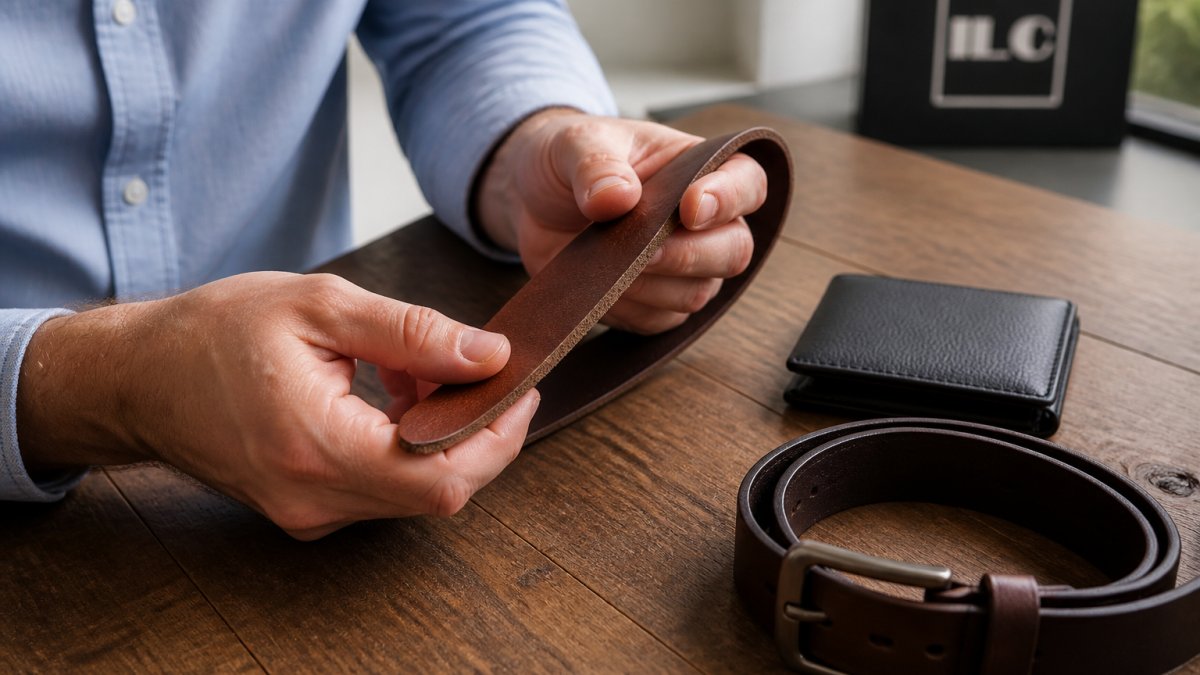
Step 1: Read the Label for Grade, Layer, and Origin
Look for a specific grade word: full grain, top grain, or genuine leather. Under U.S. Federal Trade Commission guidance, a product labeled "genuine leather" must actually contain leather, but the term does not promise a particular layer or grade. Watch for weasel phrases, "premium leather," "Italian-style," "leather-trimmed," "leather blend", that carry no defined meaning. If the tag names a tannery or a country of tanning, that is a good sign the maker is willing to be specific.
Step 2: Examine the Grain Under Raking Light
Tilt the item so light skims across the surface. Full grain shows irregular pores, healed scars, and subtle variation from panel to panel. Top grain is smoother and more uniform because the surface has been sanded, but it should still show some natural variation. A surface that looks like printed plastic, identical pore pattern repeated across the whole piece, is usually an embossed split or a synthetic.
Step 3: Inspect the Edges
Cut edges are the single most honest part of a leather good. Real leather shows a dense, fibrous cross-section, often with visible layers. Bonded leather shows a crumbly, uniform, particle-board-like edge. Synthetic shows a fabric or foam core. A painted or folded edge can hide a lot, so look for at least one raw or burnished edge you can study.
Step 4: Turn It Over and Read the Backing
Flip the item. A suede-like, fibrous back is consistent with real leather. A woven fabric backing, a knit backing, or a plastic film usually means bonded leather or a synthetic. Note that some genuine leather goods use a fabric lining over the back, that is fine, but the leather itself should still be visible somewhere.
Step 5: Press and Release the Surface
Press your thumb firmly into the surface and release. Real leather wrinkles in fine, irregular lines and springs back. Synthetic tends to stay flat or crease in sharp, angular folds. Heavily corrected grain may barely wrinkle at all because the finish has sealed the surface. This test tells you about the finish, not the fiber strength underneath.
Step 6: Smell It
Real leather smells like leather, a warm, slightly animalic scent. Synthetic smells like plastic, glue, or nothing at all. This is a useful confirmation, not proof. A heavily finished corrected grain can smell faintly of leather while still being a weaker material.
Step 7: Check the Construction at Stress Points
This is the step most buyers skip, and it is the one that predicts lifespan. Look at where the item flexes or bears load:
- Belts: the fold at the buckle and the holes. Thin leather cracks here first.
- Wallets: the spine fold and the corners. Reinforced stitching extends life.
- Bags: the strap attachment, the handle roots, and the bottom corners.
Stitching should be even, tight, and locked off, not loose or single-stitched at a high-stress seam. Rivets and hardware should feel solid, not hollow.
A two-minute inspection can rule out bonded leather and synthetics. It cannot certify durability. Use the checklist to eliminate the obvious fakes, then use the construction and test-data questions to judge the rest.
What the Checklist Cannot Tell You
Even a perfect inspection has blind spots. You cannot see the tannery's retanning and fatliquoring process, the actual thickness of the hide in millimeters, or how the finish will behave after a year of flexing. That is why the checklist is a filter, not a verdict. Pair it with the seller questions in the section below, and treat any claim that cannot be documented as marketing.
Telling Top Grain Apart from Corrected Grain, Split, Bonded, and Synthetic Lookalikes
Leather terminology is not a clean hierarchy. It is a mix of industry grades, marketing words, and a few terms with actual legal weight. Understanding which is which is the fastest way to avoid paying top-grain prices for a bonded-leather product.
| Type | What It Actually Is | Typical Durability | How to Spot It |
|---|---|---|---|
| Full grain | Whole outer hide, grain intact | Highest | Visible pores, scars, variation |
| Top grain | Outer layer, surface sanded | Good | Smooth, uniform, real back |
| Corrected grain | Top grain, heavily sanded and coated | Fair | Plastic-like, printed pattern |
| Split leather | Lower layer of the hide | Weak | Fuzzy back, no natural grain |
| Bonded leather | Shredded scraps glued to a backing | Poor | Peels, crumbly edge, fabric back |
| Synthetic (PU/PVC) | Plastic | Poor | Plastic smell, flat feel, uniform |
What Each Label Does and Does Not Guarantee
"Top grain" tells you the leather came from the outer layer of the hide.
"Split leather" comes from the lower layer of the hide, below the top grain.
"Bonded leather" is shredded leather scraps mixed with a binder and glued to a fabric or paper backing.
ILC Men’s Top-Grain Leather Ratchet Belt →
"Genuine leather" is the weakest of the leather labels. Under U.S.
"Synthetic" or "faux" leather is polyurethane or PVC. It does not develop a patina.
The Label Trap
The most common mistake buyers make is treating "top grain" as a durability grade. It is a layer description. Two products with the same label can differ by a factor of two in thickness and by years in lifespan. The label is a starting point, not a conclusion.
How to Verify a Claim You Cannot See
If you are buying online and cannot inspect the item, ask the seller four questions in writing:
- Which layer of the hide is this, full grain, top grain, or split?
- Is the grain natural or corrected/embossed?
- What is the leather thickness in millimeters?
- Can you provide abrasion and colorfastness test results?
A seller who answers all four with specifics is selling a product they understand. A seller who deflects to "premium quality leather" is telling you something too.
What Top-Grain Leather Quality Looks Like in a Finished Belt or Wallet
Good top grain shows up in the small details, not the marketing copy. On a finished belt, look at the edge finish, the stitching, and how the strap feels in your hand.
A quality belt has:
- Clean, sealed edges that won't fray
- Even stitching with no loose threads
- A strap that bends without cracking
Our Leather and Hide Council guidance notes that edge finishing separates well-made goods from cheap ones.
The same rules apply to wallets. Our ILC Men's Top-Grain Leather Bifold Wallet pairs a top-grain exterior with a microfiber lining and seven card slots.

Durability by Use Case: Belts, Wallets, and Daily Wear
Durability depends on how you use the item. A belt takes constant flexing and friction. A wallet sits in a pocket, exposed to sweat and body heat.
- Belts: The strap bends at the buckle every time you sit. Thin top grain cracks there first.
- Wallets: Corners wear fastest. Reinforced stitching extends life.
- Daily wear: Rotate between two belts to double their lifespan.
Environment matters too. Moisture and sunlight break down leather fibers. A belt worn in humid climates ages faster than one in dry conditions.
How to Care for Top-Grain Leather So It Ages Instead of Cracking
Caring for top grain leather comes down to three habits: clean it, condition it, and keep it dry.
- Wipe with a dry cloth after heavy use
- Condition every three to six months
- Store away from direct sunlight
A little care goes a long way. Conditioned leather stays supple and resists cracking. Neglected leather dries out and splits at stress points.
The Leather Naturally care guide recommends conditioning based on climate, not a fixed schedule.
Questions to Ask Sellers Before You Buy
Ask direct questions and expect direct answers. A seller who can't name the leather grade or tannery is hiding something.
- What grade is this leather: full grain, top grain, or bonded?
- Is the grain corrected or natural?
- Where was the hide tanned?
A confident seller answers all four without hesitation.
Our ILC Men's Top-Grain Leather Ratchet Belt uses a top-grain strap with a zinc alloy buckle and a cut-to-fit design. It ships from the USA with a 30-day return policy, so you can inspect the leather yourself.

Frequently Asked Questions
How can you tell if top grain leather is good quality?
Check three things. First, the grain: a quality top grain hide shows a fine, slightly uneven surface, not a plastic-smooth one. Second, the edge: look for a solid, tight edge rather than a fuzzy, layered one that suggests a split or bonded construction. Third, the backing: a suede-like reverse side indicates real leather, while a fabric or foam backing usually means synthetic material. Ask the seller for the grade and origin in writing before you buy.
Does top grain leather peel or crack?
Top grain leather itself does not peel, because the outer layer of the hide is intact. Peeling usually comes from a heavy plastic coating on corrected grain or bonded leather, where the surface film separates from the base. Cracking is more often a care problem: leather that dries out from heat, direct sunlight, or repeated moisture exposure without conditioning will crack over time. Regular cleaning and conditioning keeps the fibers supple.
How long does top grain leather typically last?
With normal use and basic care, a top grain leather belt or wallet usually holds up for several years. Lifespan depends more on construction than on the leather alone: a stitched, reinforced belt outlasts a glued one, and a wallet with a lined interior resists stretching better than an unlined one. Rotating between two accessories and conditioning every few months extends wear further.
What should you check when buying a top grain leather belt or wallet?
Look at the stitching first: even, tight stitches with no loose threads signal better construction. Check the edge finish, which should be sealed or burnished rather than raw. On a belt, confirm the buckle attachment is stitched or riveted, not just glued. On a wallet, check that the card slots are lined and the fold does not crack when bent. Ask whether the item is cut-to-fit, since sizing errors are the most common return reason.
Buying leather online is a gamble when you can't feel the grain or check the backing. I Look Classy removes that risk with top-grain leather belts, wallets, and gift sets built for daily wear. Every order ships fast from the USA and comes with a simple 30-day return policy. Shop All and find a piece that ages as well as it looks.