

Does Wearing Accessories Look Good? Men's Style Guide
Table of Contents
- Why Accessories Change How an Outfit Reads
- How to Accessorize Men's Outfits Without Overdoing It
- Men's Accessories for Work: What Looks Professional
- How to Match a Belt and Shoes (and When You Don't Have To)
- Men's Bracelet Styling: Scale, Color, and Layering
- Face Shape, Proportion, and Scale: Why Some Accessories Look Better on You
- Comfort, Budget, and Personal Preference: When Accessories Look Good on You
- Frequently Asked Questions
Last Updated: October 17, 2026
Why Accessories Change How an Outfit Reads
Yes, wearing accessories looks good. The right accessories turn a plain outfit into a finished one, adding detail, color, and personality that clothing alone cannot deliver. At I Look Classy, we see the same pattern again and again: the difference between "getting dressed" and "looking put together" usually comes down to the details. A simple outfit with the right belt, watch, and bracelet reads as intentional. The same outfit without them reads as unfinished.
Accessories also do quiet work on proportion. A belt breaks up the line between shirt and trousers. A bracelet adds weight to a bare wrist. A scarf fills the open space at the neck. Each one changes how the eye moves across your silhouette.
- Detail: accessories give the eye somewhere to land
- Color: one accent lifts a neutral outfit
- Structure: belts and shoes frame the whole look
- Personality: your choices say something about you before you speak
The key is not wearing more. It is wearing the right pieces in the right amount.
How to Accessorize Men's Outfits Without Overdoing It
Start with one anchor piece, then add only what the outfit is missing. That single rule prevents most accessorizing mistakes. If your outfit already has a pattern, keep accessories plain. If it is plain, you have room for texture or color.
Here is a simple process we recommend:
- Pick your base outfit first. Shirt, trousers, shoes. Nothing else.
- Identify the gap. Bare wrist? Open collar? Plain waistline?
- Add one piece to fill that gap. A watch, a belt, or a bracelet.
- Add a second piece only if it echoes the first. Match metal to metal, leather to leather.
- Stop at three. Belt, watch, and one more is plenty for most days.
The Three-Piece Rule and When to Break It
The three-piece rule means no more than three visible accessories at once. For most men, that is a belt, a watch, and one accent. It keeps the look balanced and easy to read.
Break the rule in two cases. Casual settings forgive a fourth piece, like a bracelet alongside a watch. And formal events sometimes call for a tie bar or cufflinks that count separately. Outside those cases, three is the ceiling.
Outfit-by-Outfit Examples
Concrete examples beat theory. Here is how the rule plays out in real life:
- Jeans and a white tee: leather belt, field watch, one beaded bracelet. Done.
- Navy suit, white shirt: matching belt and shoes, dress watch, no bracelet.
- Chinos and an oxford: brown belt, brown shoes, leather-strap watch, stone bracelet.
- Blazer and dark jeans: belt, watch, pocket square in a solid tone.
Notice that each look has a clear anchor and nothing extra.

Men's Accessories for Work: What Looks Professional
Professional settings reward restraint. The accessories that look best at work are the ones nobody notices until they look closely. Think clean lines, matching metals, and quiet colors.
For the office, we suggest:
- A leather belt in brown or black that matches your shoes
- A simple watch with a leather or steel band
- One understated bracelet if your workplace is business casual
- A slim wallet that keeps your pockets clean
Skip anything loud at work: oversized buckles, bright beads, or dangling pieces. Save those for weekends. The Fair Labor Standards Act guidance on professional dress does not govern style, but workplace dress codes often do, so check your employer's policy before pushing boundaries.
A polished work look comes from consistency. Match your leathers, keep metals in one tone, and let fit do most of the talking.
How to Match a Belt and Shoes (and When You Don't Have To)
Matching your belt to your shoes is the safest rule in menswear, and it still works. Brown belt with brown shoes, black with black. The tones do not need to be identical, but they should sit in the same family.
Here is a quick reference:
| Shoe Color | Best Belt Match | Acceptable Alternative |
|---|---|---|
| Black | Black leather | Dark charcoal |
| Dark brown | Dark brown leather | Mid brown |
| Tan or cognac | Tan leather | Mid brown |
| White sneakers | No belt needed | Casual woven belt |
When can you skip the match? Casual outfits give you room. White sneakers pair with almost any belt. Textured or woven belts bend the rule. And a belt that clearly contrasts on purpose, like a dark belt with light chinos, can work if the rest of the outfit supports it.
Men's Bracelet Styling: Scale, Color, and Layering
Bracelets look best when the scale suits your wrist and the color echoes something else you are wearing. An 8 mm beaded bracelet sits well on most wrists without overwhelming them.
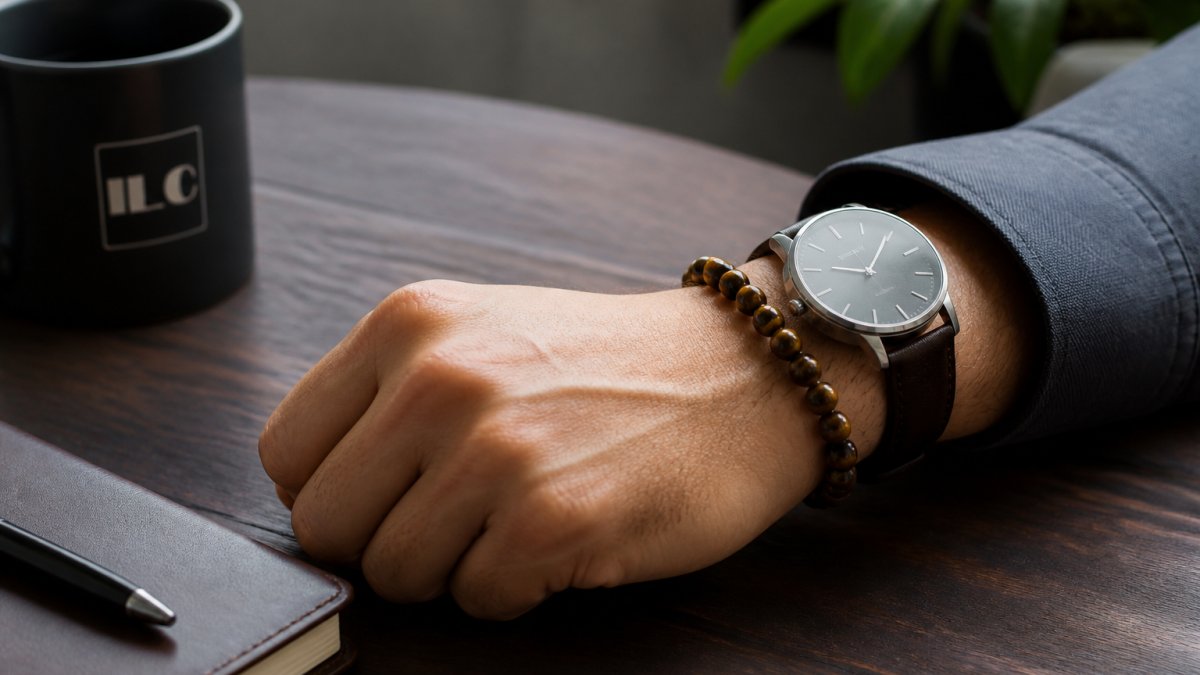
Color is where bracelets earn their place. Black lava stone works with almost anything. Our ILC Men's Natural Tiger Eye Bracelet brings golden-brown tones and polished hematite accents, and it pairs naturally with leather accessories and business casual clothing.
ILC Men’s Natural Tiger Eye Bracelet →


Layering follows one rule: contrast, don't compete. Two bracelets work when their textures differ, which is why we like pairing the tiger eye with the textured black of the ILC Men's Natural Lava Stone Bracelet.
If you want both in one purchase, the Tiger Eye & Lava Stone Bracelet Pair includes a velvet pouch and gift bag, which makes it an easy gift.
Face Shape, Proportion, and Scale: Why Some Accessories Look Better on You
Proportion decides whether an accessory flatters you, and it starts with scale. The mechanism is simple: the eye compares the visual weight of the accessory to the visual weight of your frame, your clothing, and the space around your face. When those weights are close, the piece reads as intentional.
A practical way to test scale before you buy: hold the piece up at arm's length in a mirror, then step back three feet. If you see the accessory before you see your face, it is too large for everyday wear.
Face shape matters most for glasses, collars, and hats, because those sit directly against the face and change its outline. The general pattern most stylists use:
- Angular faces (strong jaw, prominent cheekbones) soften with rounded or oval frames and softer collar shapes.
- Rounder faces gain structure from square or rectangular frames and sharper collar points.
- Longer faces balance with wider frames and lower-set bridges rather than narrow, tall shapes.
- Heart-shaped faces often suit frames that are slightly wider at the bottom than the top.
For jewelry and watches, face shape matters less than overall build and wrist size. Use these starting points, then adjust by eye:
- Broad build: wider belts (1.5 in / 38 mm and up), larger watch faces (40-44 mm), 8 mm beads.
- Slim build: narrower belts (1.25 in / 32 mm), smaller watch faces (36-40 mm), 6 mm beads.
- Tall frame: longer necklaces if you wear them, larger-scale pieces that hold their own against height.
- Shorter frame: keep accessories compact and clustered near the waist or wrist so they don't visually shorten you.
Wrist size is the most overlooked variable. Measure your wrist with a soft tape at the wrist bone. Under 6.5 in, a 6 mm bead or a 36-38 mm watch case sits proportionally. Between 6.5 and 7.5 in, 8 mm beads and 38-42 mm cases are the safe zone.
None of this is rigid. Use it as a starting point, then trust what you see in the mirror at three feet and at ten.
Comfort, Budget, and Personal Preference: When Accessories Look Good on You
An accessory looks good when you forget you are wearing it. Comfort is the test that matters most, and it beats every style rule.
Comfort has concrete signals you can check before you commit:
- Belt: you should be able to slide two fingers under the waistband when seated. If the belt leaves a red mark after an hour, it is too tight regardless of the hole you used.
- Bracelet: a stretch bracelet should rotate freely but not slide past the wrist bone. If it leaves an indentation, size up.
- Watch: the case should sit flat on the wrist bone with the band snug enough that the watch does not spin when you shake your hand.
- Necklace or chain: if you feel it against your collarbone when you turn your head, it is sitting too high for all-day wear.
Budget works the same way. You do not need a drawer full of pieces. A few well-chosen accessories, worn often, beat a pile of cheap ones.
Personal preference is the final filter, and it is also where the keyword's real answer lives. The FTC guidance on truthful advertising reminds brands to be honest about what products deliver, and that standard should guide your own choices too: buy pieces that do what they promise.
Here is a simple decision framework you can run in under a minute before you leave the house:
- Occasion: Does the setting reward restraint (work, formal) or allow expression (weekend, social)?
- Outfit: Is the base plain or patterned? Plain outfits have room for one textured or colored piece; patterned outfits need plain accessories.
- Color: Does the accessory echo something already in the outfit, shoes, belt, watch metal, or a single accent?
- Focal point: Is there exactly one place the eye lands first? If two pieces compete, remove one.
- Comfort: Can you forget you are wearing it for the next four hours? If not, swap it.
If all five pass, wear it. If any one fails, remove the piece and re-check. Most over-accessorizing happens because people skip step four.
The good news is that this is easier than it sounds. Start with one or two quality pieces, wear them often, and build from there. For a broader look at building a wardrobe that lasts, GQ's men's style guidance offers useful context on timeless choices.
Frequently Asked Questions
Do accessories make an outfit look better?
Yes, when they are chosen with intention. Accessories add visual interest, color, and texture that a plain outfit lacks, and they signal attention to detail. A simple jeans-and-tee combination reads sharper with a leather belt and a natural stone bracelet. The key is balance: one or two pieces that complement the clothing rather than compete with it. Over-accessorizing, such as stacking a watch, two bracelets, a necklace, and a pocket square at once, can make an outfit look cluttered instead of polished.
How many accessories should a man wear?
A practical guideline is three visible pieces at most for business or smart-casual settings: for example, a watch, a belt, and one bracelet. For casual outfits, two is often enough. The goal is coordination, not quantity. If your belt has a prominent buckle, keep wrist accessories simple. If you wear a statement bracelet, let the rest of the outfit stay quiet. Proportion matters too: a 8 mm beaded bracelet sits comfortably next to most watches without overwhelming the wrist.
What accessories look professional for men at work?
For most workplaces, the safest professional accessories are a leather belt that matches your shoes, a classic analog watch, and a simple bracelet in a natural material such as tiger eye or lava stone. Avoid oversized buckles, novelty prints, and noisy jewelry. Stick to one metal tone across your watch, belt buckle, and any rings. A leather wallet and a clean bag complete the picture. These pieces support a polished appearance without drawing attention away from your work.
How do you match accessories with an outfit?
Start with the outfit's dominant color and texture, then choose accessories that either echo or deliberately contrast with it. Match your belt to your shoes in tone (brown with brown, black with black) and keep metals consistent. For bracelets, pick a stone color that complements your clothing: warm tiger eye works with earth tones and navy, while black lava stone pairs with gray, white, and denim. Limit yourself to one statement piece per outfit so the eye has somewhere to rest.