

Are Expensive Leather Belts Worth It? A 2026 Review
Table of Contents
- Are Expensive Leather Belts Worth It? The Honest Answer
- How Much Should a Decent Leather Belt Cost?
- How to Tell If a Leather Belt Is Good Quality
- How Long Does a Leather Belt Last?
- Leather Belt Cost Per Wear: The Math That Decides It
- When an Expensive Leather Belt Is Not Worth It
- Verdict: What to Look For Before You Buy
- Frequently Asked Questions
Are Expensive Leather Belts Worth It? The Honest Answer
Last Updated: October 16, 2026
Are expensive leather belts worth it? At I Look Classy, we sell top-grain leather belts, so we have a clear stake in this answer.

Here is the uncomfortable part most buyers miss: the price tag tells you very little on its own.
A leather belt is a strip of tanned animal hide, cut from a single piece or bonded from layers, fitted with a buckle and finished along its edges.
How Much Should a Decent Leather Belt Cost?
A decent leather belt typically runs $50 to $80. Below that range, you are usually buying bonded or split leather with a surface coating.
Retailers rarely explain what changes between tiers:
| Price Band | Typical Leather | Construction | Expected Life | Cost Per Year |
|---|---|---|---|---|
| Under $30 | Bonded or coated split leather | Glued layers, stitched or heat-sealed edges | 6-18 months | $20-60 |
| $50-80 | Top-grain or full-grain | Single-piece strap, stitched or burnished edges | 3-8 years | $7-25 |
| $120+ | Full-grain, often branded | Single-piece strap, premium hardware | 5-15 years | $8-25 |
The middle and top bands land in roughly the same cost-per-year territory; the difference is upfront cash flow and brand markup.
Our own belts sit at $59.99, in the range where the leather is solid rather than coated.
How to Tell If a Leather Belt Is Good Quality
You can judge a belt in about 60 seconds by checking four things: the back of the strap, the edges, the stitching, and the buckle. If any one looks cheap, the belt is cheap.
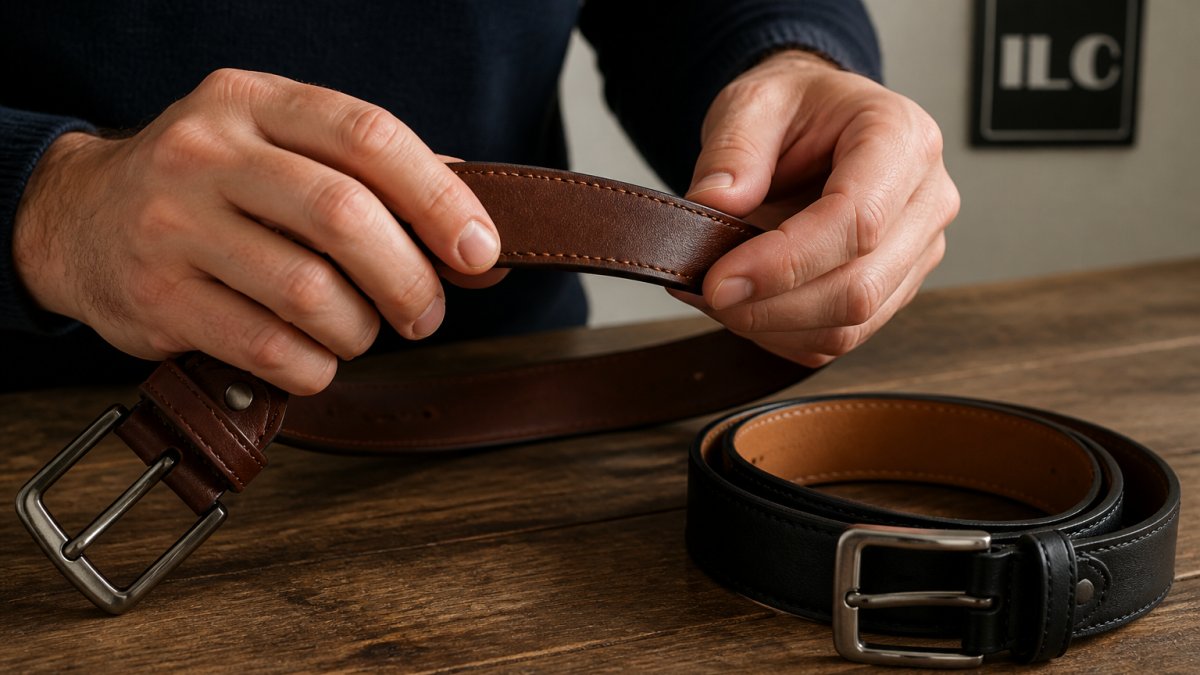
Start with the leather grade, because the label is where sellers get vague. Full-grain leather is the top layer of the hide with the grain intact, showing natural variation, faint scars, and visible pores. Top-grain leather has the top layer sanded lightly for a more uniform finish, which is what our belts use. Genuine leather is a legal marketing term that usually means split leather, the fibrous lower layer, often with a polyurethane coating sprayed on top.

Here is what to check in person:
- The back of the strap: Rough, suede-like texture is normal for solid leather. A smooth, uniform, plastic-looking back often means a bonded or coated core.
- The edges: Burnished, sealed, or stitched edges hold up. Raw, fuzzy edges fray and split.
- Stitching: Even spacing, no loose threads, and a consistent line. Single stitching near the buckle is a weak point.
Decoding a Product Listing Before You Buy
When you cannot touch the belt, the listing tells you what the seller is hiding. Read it like an inspector:
- "Genuine leather" with no grade named. The biggest red flag. If the seller had full-grain or top-grain, they would say so. Vague wording usually means split or bonded leather under a coating.
- No photo of the back of the strap. A seller proud of solid leather shows the rough back; one hiding a coated core shows only the smooth front. Treat a missing back photo as a red flag.
- No close-up of the edge. Look for a burnished, painted, or stitched edge. If every image crops the edge out, assume it is raw and will fray.
A Quick Grade-and-Construction Checklist
Use this to sort any belt into a tier before deciding what it is worth:
- Full-grain, single piece, burnished edge, named hardware: top tier. Expect the longest life and the highest price.
- Top-grain, single piece, stitched or burnished edge, named hardware: strong mid-tier. This is the sweet spot for most buyers.
- Split or bonded leather, glued layers, raw or heat-sealed edge, "metal" buckle: budget tier. Expect a short life and a coating that peels.
If a listing does not let you place the belt in one of those three tiers, the seller is not giving you enough to justify a premium price.
How Long Does a Leather Belt Last?
A well-made top-grain or full-grain leather belt lasts 3 to 8 years with regular wear, and often longer with occasional conditioning. A bonded or coated belt typically fails within 6 to 18 months.
The failure mode matters as much as the timeline. Cheap belts do not wear out evenly; they crack at the buckle fold, peel along the coating, or split at the stitching.
Reading the Evidence of Real Wear
You do not need a lab to judge durability, just know what a worn belt looks like at each price tier:
- A coated or bonded belt after a year: a hairline crack across the strap where it bends at the buckle, a lifted or bubbled edge where the coating separated from the backing, and a smooth, plastic back that has not softened at all.
- A solid leather belt after a year: a soft crease at the buckle fold that springs back when you flex it, edges that have darkened but not frayed, and a back that has taken on a slightly burnished feel from contact with clothing.
- A solid leather belt after five years: a deep, even patina across the strap, a crease that has set but not split, and hardware that still holds its shape with only surface scuffs.
The tell is always the fold at the buckle, the highest-stress point on any belt, and where cheap construction reveals itself first.
What the Wear Pattern Tells You Before You Buy
When evaluating a belt, new or used, the same logic applies in reverse. A seller showing a five-year-old belt with an intact fold, un-frayed edges, and a named buckle is showing you evidence; one showing only a crisp new product shot is showing you nothing.
What shortens a belt's life:
- Wearing the same belt every day. Leather needs a day to dry out between wears.
- Machine washing or soaking. Water strips the oils that keep the hide flexible.
- Storing it coiled tightly. Roll it loosely or hang it.
What extends it:
ILC Men’s Top-Grain Leather Ratchet Belt →
- Rotating two belts instead of wearing one daily
- Wiping the strap with a dry cloth after heavy use
- Conditioning once or twice a year with a leather balm
Leather Belt Cost Per Wear: The Math That Decides It
Cost per wear is the purchase price divided by the number of times you wear the belt.
Run the numbers on two scenarios:
- Budget belt at $25, worn 200 days a year, replaced after 1 year: $25 ÷ 200 = $0.13 per wear.
- Top-grain belt at $59.99, worn 200 days a year for 5 years: $59.99 ÷ 1,000 = $0.06 per wear.
The cheaper belt costs more than twice as much per wear once you account for replacement.
The same logic applies across our range. A single belt at $59.99 and a belt-and-wallet gift set at $125.99 both spread their cost across years of daily use; the set covers two items at once, which is why it works as a gift.
Cost per wear, not sticker price, is the number that matters. A $60 belt worn for five years beats a $25 belt replaced annually.
When an Expensive Leather Belt Is Not Worth It
Three situations where we would tell you to skip the premium option:
You need a belt for a costume, a single event, or a short season. If you will wear it a handful of times, a budget belt does the job. Cost per wear only favors quality when the wear count is high.
The expensive belt is not actually better made. A $150 belt with a coated strap and glued edges is worse than a $60 belt with a solid strap.
You will not maintain it. Leather that never gets conditioned and is worn daily without rest will fail regardless of grade, so the premium leather is wasted.
Where the premium does pay off: daily wear, professional settings where a cracked belt is visible, and anyone who would rather buy once than shop annually.
Verdict: What to Look For Before You Buy
Buy the belt whose leather and construction justify the price, not the one with the biggest name. For most people, that means a top-grain or full-grain single-piece strap with stitched or burnished edges and solid hardware.
Before you check out, confirm these five things:
- The listing or tag states the leather grade, not just "genuine leather"
- Photos show the back of the strap and the edge finish
- The buckle is described as solid brass, stainless steel, or zinc alloy
Our ILC Men's Top-Grain Leather Ratchet Belt fits that checklist at $59.99, with a top-grain strap, a zinc alloy buckle, and a hidden ratchet track that adjusts the fit in small increments instead of fixed holes. For the belt and a wallet together, the ILC Top Grain Leather Black Ratchet Belt & Black Wallet Gift Set covers both at $125.99, with gift packaging included.

The answer to whether expensive leather belts are worth it comes down to one question: will you wear it enough for the leather to earn its keep?
Frequently Asked Questions
Are expensive leather belts worth the extra cost?
It depends on the leather grade and how often you wear it. A belt made from top-grain or full-grain leather with solid stitching and a zinc alloy or brass buckle can last several years of daily use. Divide the price by the number of wears and the cost per wear often drops below a budget belt that cracks or peels within a year. The upfront price matters less than the material and construction you get for it.
How much should a decent leather belt cost?
A well-made top-grain leather belt generally starts around $50 to $60. At that price, you should expect a leather strap rather than bonded or coated leather, a metal buckle that will not bend, and clean edge finishing. Belts under $20 usually use split leather or a leather-look coating over a fiber core, which is why they tend to crack at the holes and fray at the edges.
How long does a leather belt last?
A quality top-grain or full-grain leather belt worn daily typically lasts three to five years or more, especially if you rotate it with a second belt and condition the leather once or twice a year. Budget belts made with bonded or coated leather often show cracking, peeling, or stretched holes within six to twelve months. The biggest lifespan factors are leather grade, stitching quality, and how the belt is stored.
How can I tell if a leather belt is genuine?
Look at the back of the strap and the cut edges. Genuine top-grain or full-grain leather shows a natural, slightly rough fiber texture on the underside and a solid, consistent edge. Bonded or faux leather often has a uniform fabric backing or a plastic-looking edge that peels. Also check the stitching: real leather belts use tight, even stitches, while cheap belts may rely on glue or sparse stitching that pulls apart.
Is a ratchet belt a good alternative to a traditional hole belt?
Yes, if you want a precise fit. A ratchet belt uses a hidden track instead of fixed holes, so you can adjust it in small increments throughout the day. That matters if your waist size fluctuates or you wear the belt over different trousers. Options like the ILC Men's Top-Grain Leather Ratchet Belt at $59.99 use top-grain leather and a zinc alloy buckle, and the strap can be shortened from the buckle end for a custom fit.
The real challenge is not deciding whether quality matters; it is finding a belt that actually delivers it without charging for a logo. I Look Classy builds its belts around top-grain leather, zinc alloy hardware, and a ratchet fit you can fine-tune, backed by fast shipping and a 30-day return policy. Browse the full collection and pick the belt that will still look right in five years.